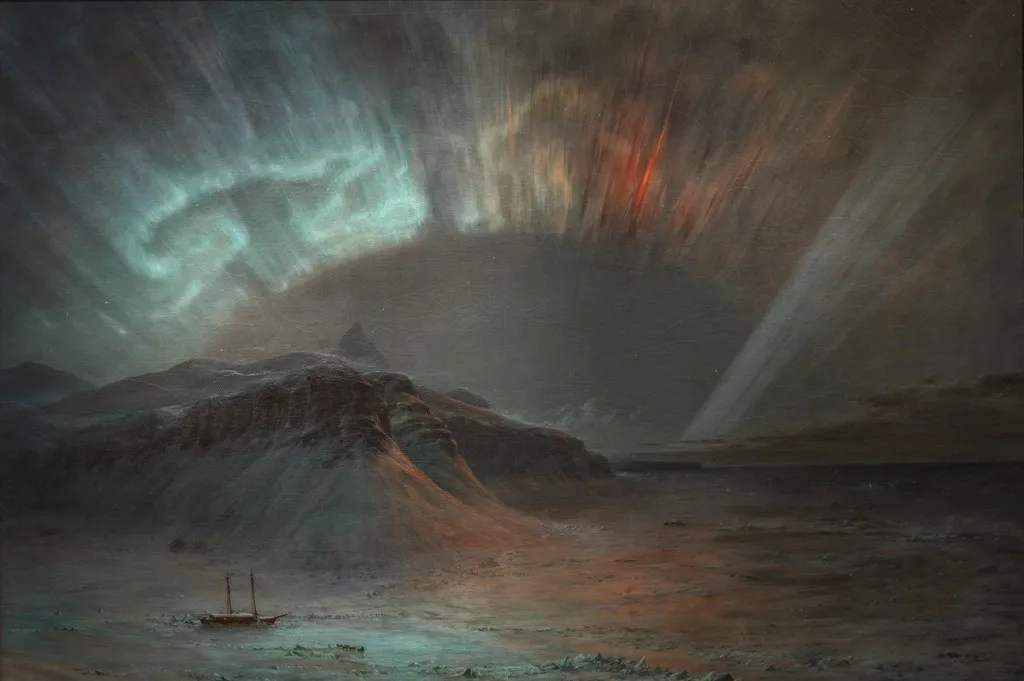
In Anayr the sun shone bright, even in those days considered dark for the ruling races of the world, but that mattered little to the Lumar, the oldest living dominant race in the whole world. The Lumar were children of the moon, or so their sages said. Their life was nocturnal, and the sun was rarely seen by the reddish or violet eyes of those gray-skinned people. Many cities were raised in the small hours of Anayr by the Lumar, and one of them was Dávia, the frozen city.
Dávia lay at the far south of the world, near the great ice deserts. It was not home to many stories, nor was it a grand city; it was nothing more than a simple city of simple houses and simple people, and not even its military stood out among the other Lumarian cities. Yet its location drew travelers from all over the world, even from other races. The city lay near the entrance to Belian, the frozen forest, one of the largest forests in the world and without a doubt the most mysterious. Legends said all the cold in the world came from it, and all the ice that bathed that region, the ice that had created the white deserts. The oldest books spoke of the heart of Belian, a blue jewel rarer than any other, a spirit of ice and cold, crystallized and forever alive. It was for that jewel that many visited Dávia on their way to Belian, for no Lumar had ever seen it, and all of them desired it.
“Mother, is it true what they say? Does this jewel really exist? If no one has ever managed to take it, why do they say it exists?” Daviane’s sweet voice could charm even the wildest ears. She was a simple girl, like all the people of Dávia, but unlike them, Daviane always wanted to know more. She was curious; she carried a hunger for knowledge and a love of mystery. She was still twelve that day and had already read more than 30 books that only old people read, books of knowledge.
Daviane’s mother said nothing in reply. She knew touching that subject was a bad idea. Her husband, her daughter’s father, had been one of those lost in Belian in search of its heart and had never returned. Daviane knew this, and that is why she studied the forest so much. Yet telling the girl the jewel did not exist would be the same as telling her that her father had died for nothing.
“The Lumar are greedy. Not everyone gets used to the simplicity you see in our home, my daughter. Your father was one of the greedy ones. They always run off to cling to anything that gives them hope of change. Whether the jewel exists or not, it is a source of hope for those who have little and dream of having much. Have you thought about how much recognition the one who owns it will have? Or how much money they will be given? Or how many titles they will receive from their king?” Daviane paid close attention to her mother’s words. She was always careful, but she never failed to find the truth behind the lines she read.
When the sun was rising, the hour when the Lumarians usually went to sleep, Daviane had an idea, and unlike her mother she did not sleep. She got out of bed, tied back her precious golden hair, let her violet eyes search the whole room for anything useful for her next steps, and gathered what she found. With a bag on her back and a dagger at her waist, the girl of only twelve left the city on her way to Belian. She needed to see with her own eyes what none of the Lumar had found. She felt no fear, no regret, and never once thought of giving up along the way. Daviane was without a doubt gifted with something that always pushed her forward when it came to the search for knowledge.
On the way to Belian she hummed the songs her mother had taught her a few years before, songs about the past of the lands of Anayr, about the forests of the Venar, children of nature. Venair was the name of that home of colorful trees and strong nature. She also sang about the invasion of the Numari, the sea peoples who came from afar in their ships and looked at the Lumar with hatred from their three eyes and never made friends. She finished her songs when she reached the entrance of Belian, very cold, singing the last verse about the luminous forests of the north, home of much light, where at night the trees shone like stars and by day sheltered nocturnal beasts.
“Hello, great Belian. I have come to win your heart,” she said, stopping, setting her bag on the ground and taking out a thick blanket her mother had given her to use while sleeping on the coldest days. She wrapped herself in it and put the bag on her back again. Daviane’s next steps could be her last, and it was at that moment, and only then, that she looked back and saw the vastness she had walked. She saw her footprints vanishing in the wind and felt on her skin the sun few Lumar liked to feel, and she wondered whether her father had walked this same path.
The first moments in the forest were not as frightening as Daviane had imagined, but when hunger and thirst struck, she felt she might never get out of the forest. She had brought little food, her water had frozen just before she went in, and there was no fruit on those gigantic, whitish trees. She stopped at the foot of one of the trees, leaned against its root and opened her bag again. She needed to eat at least one of the last three pieces of fruit she had brought. That is when the first danger showed itself to the girl: ice birds, known to the Lumar as Belinares, the birds of Belian. At least five landed on the tree Daviane was leaning against and were now watching her eat. Without thinking twice, Daviane drew her dagger, her only weapon, and kept it in her hand.
After eating and resting a little, the girl started walking again. The Belinares were still following her, and she had not put her dagger away. The birds were white and shimmering, and the beating of their wings shook loose snowflakes. It was said their beaks were so strong they pierced bone with ease. They measured from 80 cm to 1.10 m from wingtip to wingtip, and they were the ones who feasted on the bodies of those lost in the forest. Those birds would probably follow her until they saw her sleep or drop dead somewhere, and then they would enjoy her flesh.
Daviane’s first fright came when she thought about sleeping. She had found a cave, well, not technically a cave, but a hollow in a tree big enough to shelter one or two people. She went in, and what she found was a body. It was rotten, but it did not stink; the ice covering it had stripped away that sad trait. There was nothing useful on it. How long had it been there? she wondered. Could it be her father? She very much doubted it. Her mother said her father always walked with one or two swords at his waist, and this one had nothing but small, dull knives. But yes, it was a Lumar. She threw the body out of the “cave” and let the Belinares devour it, piercing the crust of ice over the frozen, rotten body and nibbling its cold flesh. She dragged snow in front of the entrance, made a lid out of the piled ice, and fell asleep inside. There was no doubt it was the worst sleep of her life, and the coldest too, and she woke every minute, afraid the ice lid would crumble and the Belinares would get in.
When she woke, Daviane felt hungrier and thirstier than ever, and she was already thinking of giving up and going home, but the question that haunted her was: “Do I know the way back?” She had not marked the path, and her footprints were gone, along with the Belinares, who were no longer there; only bones remained of the poor Lumar she had found. Despair and fear slowly grew in Daviane’s heart. She needed to find the jewel, the heart of Belian, quickly, or she would die there, like that Lumar, like her father. So she started walking faster. Little did she know that walking slowly was an even better option, since it would save the last of her energy. Walking fast, she stumbled here and there, and once she tripped on a root and fell, hurting her arm and forehead. She was definitely out of luck. After a while she dropped her bag somewhere so she could walk even faster. Her hope was to find the mighty, magical jewel, and it would get her out of there, however a child’s mind imagined it would manage such a thing.
It was when she no longer had the strength to walk, or to scream, or even to crawl, that Daviane gave up. She clung to a giant tree and tried to dig into its trunk to make another “cave”. Now she understood how the Lumar she had found had died. Now she felt fear; she regretted coming and certainly had no courage left to go on. It would be better to die there of hunger and thirst than be torn apart by whatever beasts had been watching her since she came in, because she knew she was not alone, and had known it for a long time. Daviane even gave up digging when she realized it was madness to do it with her bare hands. She looked up at the treetops and smiled. She had come so far and done so much, even though she was just a little girl of twelve. She was proud of herself, and she knew that if her mother saw her like this she would be proud too, or maybe she would just give her one of her biggest lectures.
“I give up, Belian. You can take me wherever you took my father and all the other Lumar who came in here, strong and noble warriors, greedy ones and travelers.” Those were her last words before she felt the cold grow exponentially.
His footsteps were what made the cold grow: his approach, his glow, his existence. A Venar of ice, Belian. Daviane was the only one among the Lumar to see this spirit of great light. He came close and saw her dying, but unlike all the others who had walked and died there before, she was a girl, a female of her race, and pure, for in her twelve years she barely knew the true meaning of living. She knew neither love nor terror, and her worst moments had come down to sleeping in great cold and fear. Without a doubt, a Venar could not let her die there.
The Venar were the first in Anayr, the first race in the world, the true children of nature. They were the lords of the Venair forest, the forest that covered the world, and they guarded it until its fall at the dawn of the Numari race and the dawn of the Lumar race, when many regions died and only one remained, today in the East. Once there were Venar for all things, and nature gave them the task of making the world what it was, from fire to air, from rocks to water, from clouds to sea foam, from life to death, from ice to ore, from leaves to animals. Of them, the Lumar knew the songs far better than the presence.
Daviane’s eyes closed when she saw her savior, for she felt peace in his cold and calm in his icy touch. He was light without a face, a voice without speech. He told her to be calm, and that left her as he wished. Daviane woke lying at the edge of the forest, with her bag, wrapped in her blanket, with neither hunger nor thirst; only the wounds on her arm and forehead remained as a reminder. The sun was setting on the horizon, and from far off, Lumar riders were coming toward her on strong black horses. They were looking for her on her mother’s behalf, and when they found her, she told them the story of her journey, but no one believed her, because she was too young to have done so much, especially since she had left home no more than 12 hours earlier. She felt confused, doubting even herself, but she laid the blame for all of it on the Venar who had saved her. And now she was not only the only Lumar to have seen a Venar, but also the only one to have entered the frozen forest and come out alive, and the only one who knew the truth behind the forest: there was no magic jewel or anything else that drew the Lumar and other races there. What there really was, was a sad, lonely Venar, the only one of the realms of ice. In the end, her father had indeed died for nothing.
David Stéfano, writing as Kael Angeli