Intro: Writing Interactive Narratives
When you choose to write games instead of other media, like film, animation, TV or even books and comics, you are choosing something more complex and demanding, but also more fun. Interactivity with the audience is what makes games so interesting: the way the narrative reacts to your steps, to your controls, even if it only reveals itself while you explore a seemingly simple environment.
That is the biggest difference between watching a movie and playing a game: interactivity. It is why game movies are not that successful; movies are not (yet) interactive, especially in theaters. How do you adapt an interactive narrative of at least 10 to 15 hours into a 2-hour movie? That is why the serialized format works better for game adaptations, like The Last of Us, which adapts over 9 hours (across the 9 episodes of the first season) a game whose main campaign lasts about 14 to 15 hours.
When I decided to become a game writer, I had already been through other areas of the games industry, from 2D and 3D art to level design and even game design, but writing remained my passion. What I did not know was that in practice it would demand a bit more of me. Partly because back then I did not know the narrative structure of a game, but mostly because I did not understand the landscape I was in.
In the Brazilian games market it is very common to pile up roles at an indie studio. I found out that very few studios hired someone to be only a writer, so I tried to understand better how that worked in practice by asking myself: who makes the stories of the games I know?
That is when I discovered the Narrative Designer, a role that fit very well with what I wanted to do. Reading the job description, all I could think was: "I REALLY WANT TO BE THIS PROFESSIONAL". But nothing is so easy that wanting it solves it, and that is fine. Getting used to the daily struggle is part of being a professional writer in Brazil.
What does a Narrative Designer do?
Before we get into the main topic of this issue, let us first understand what a Narrative Designer does.
This is the professional responsible for making sure every element of a game is aligned, creating a cohesive experience. From the setting and in-game interactions to the interfaces, sound effects, music and characters, everything must tell the same story. To do that, they need constant dialogue with different areas of the studio, like artists and programmers, making sure everyone works in sync.
They are also the central point that makes sure the narrative integrates well with the game’s mechanics. If the direction calls for a puzzle game, they make sure the story is in harmony with the technical side of that game.
And this is the professional who can make your game tell good stories even without dialogue or text.
Now that you know both what a narrative designer does and the basic aspects that set games apart from other media, let us get to the subject: The Plucky Squire, called O Escudeiro Valente in Brazilian Portuguese!
PS: From here on, if you have not played The Plucky Squire, continue at your own risk. There will be spoilers needed for the narrative analysis of this game.
Once Upon a Time…
That is how the game begins, with an introduction narrated (in the Brazilian version) by Mauro Ramos, the Brazilian voice of Shrek and Pumbaa, and here we meet our protagonist, Jot (Pontinho in Portuguese). What surprises you right away is that all this narration, like the game itself, happens as a children’s storybook opens!
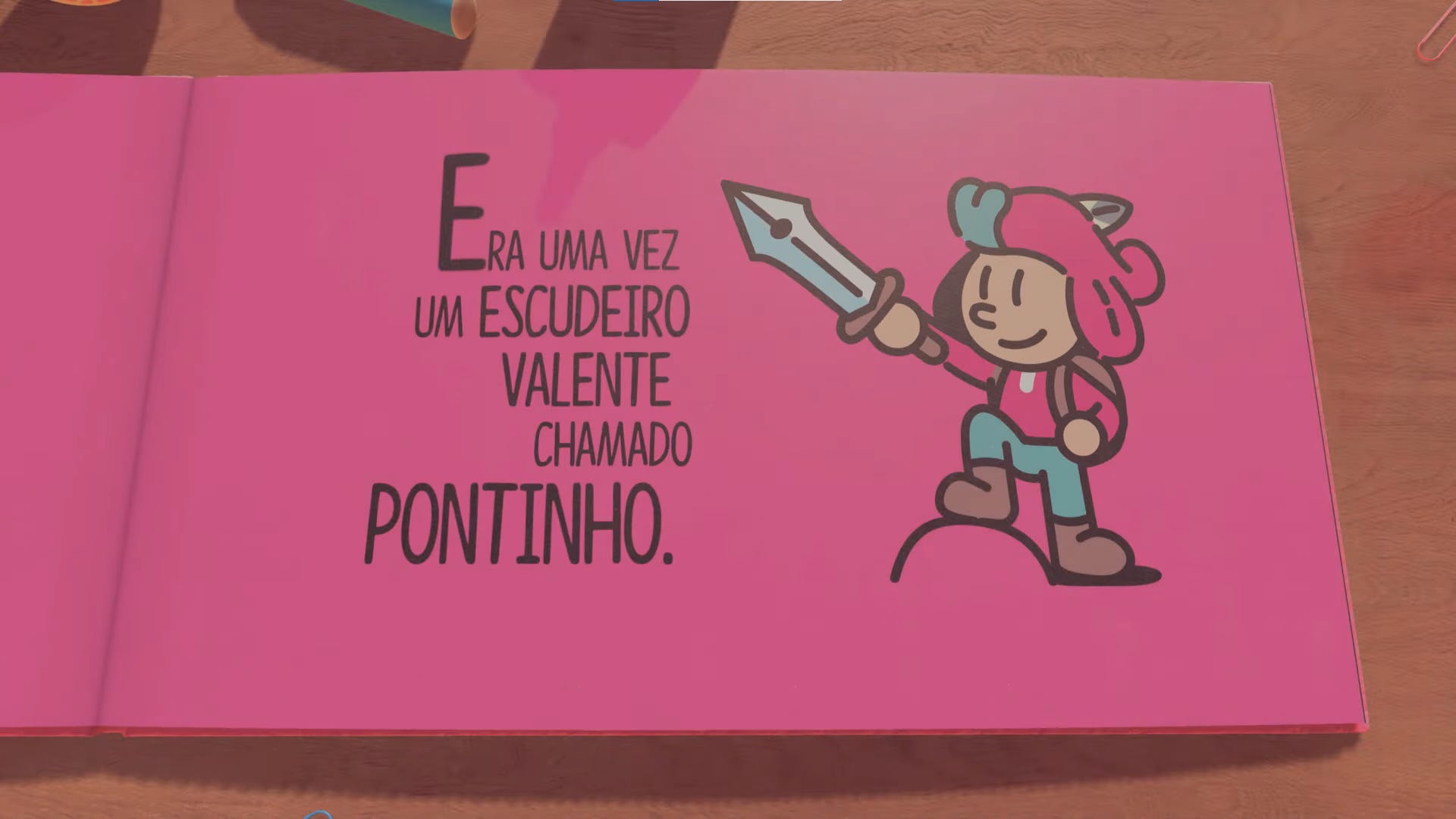
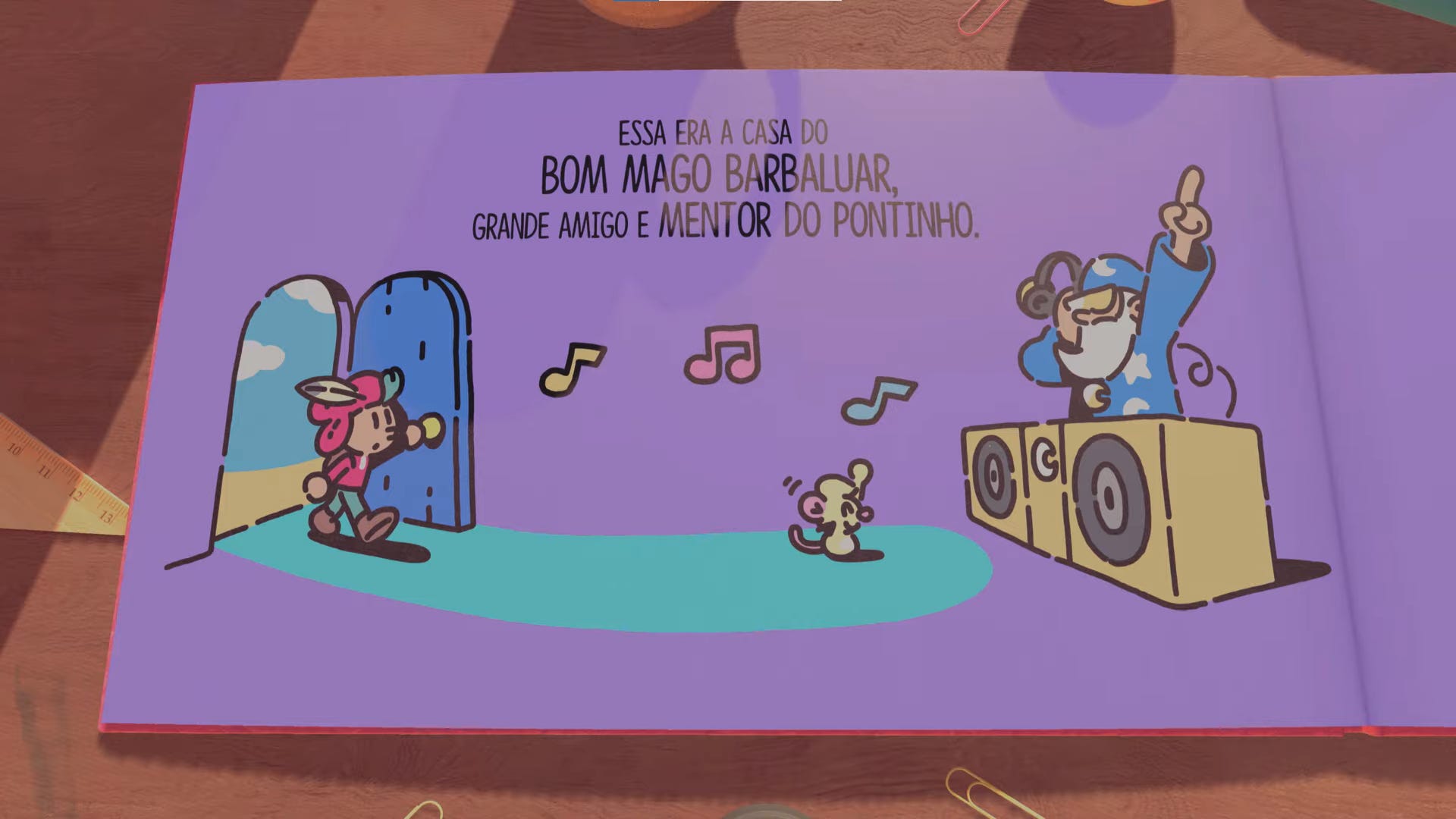
Here, in this book, Jot has always been the people’s hero. He has saved the world many times and lived all sorts of adventures, always fighting the villain Humgrump, a dark wizard. Besides being an adventurer and a squire, Jot is a writer, and his greatest weapon is a quill, which he uses as a sword. We also meet Moonbeard, Jot’s mentor and ally, a rather… different wizard. Check out his look:
The story begins with problems popping up across the kingdom of Mojo, simple ones at first. The game shows its first surprise when we have to defend bees in a hive being attacked by a “honey badger”, and the moment we arrive for the fight, the game turns into an amazing reference to an old game called Punch-Out!!, a boxing game.
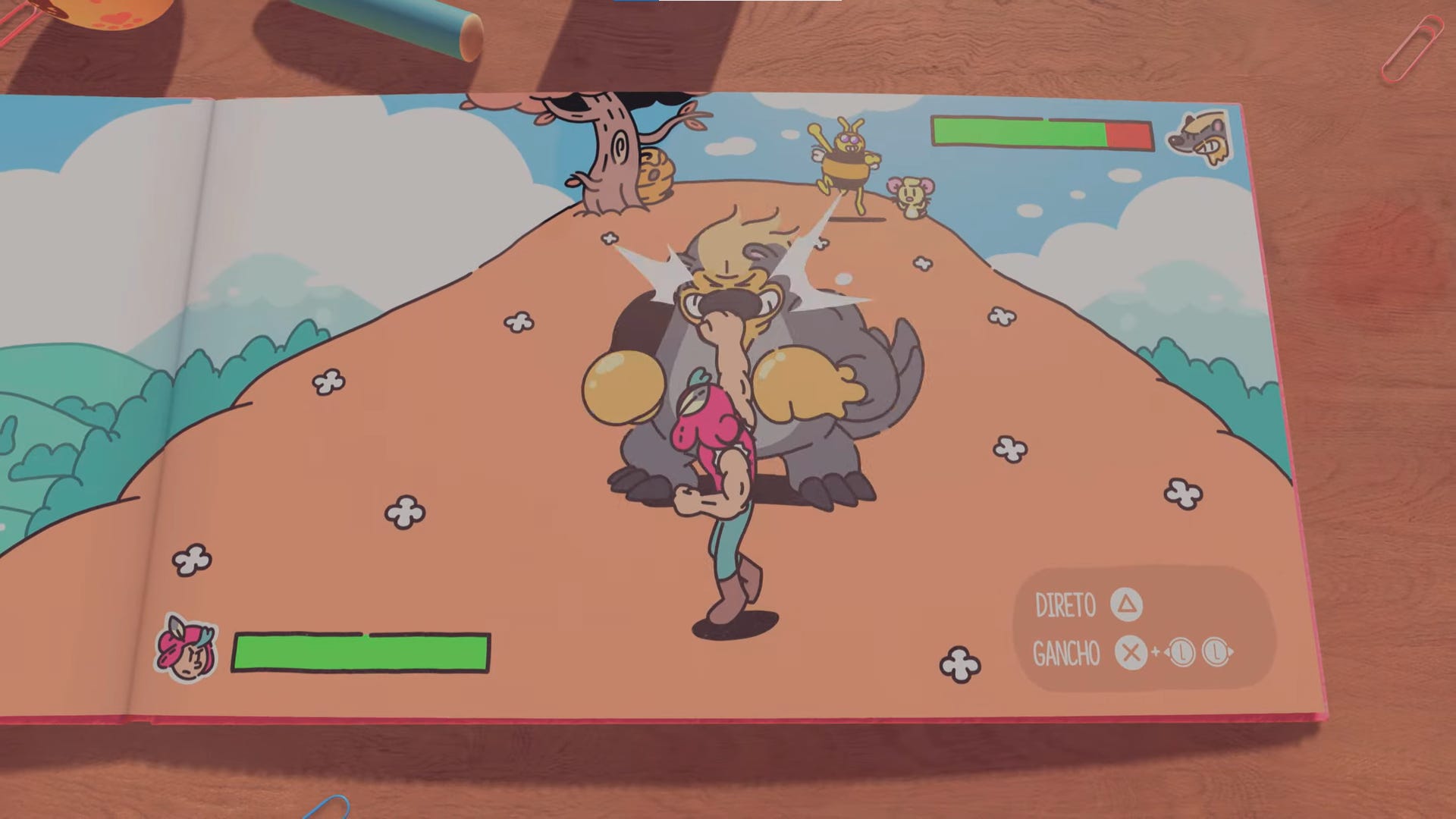
It is in these sudden gameplay shifts, these breaks in pacing and in the game loop, that everything gets more interesting.
After the fight we meet our two main allies, Violet, a witch who uses colors to defend herself, and Thrash, a rock-loving mountain troll. I will talk more about them later.
After an introduction to the basic gameplay, distinctive gameplay twists, our allies and lots of fun, it is time to reveal the real problem, the bigger challenge. This is where Humgrump enters the story, showing that not only the world is in danger, but the whole reality Jot and his friends know.
PS: The images I used in this section were recorded in a playthrough I posted on YouTube; you can watch it by clicking here. It was a series of videos covering the whole game, ending with two very long livestreams. The first video has less saturated colors because of some mistakes on my part, but it is still fun to watch. The playthroughs have no commentary and no editing, captured straight from the PS5 to YouTube.
The silent protagonist
Now that we know the game’s basic premise, let us talk about a very important narrative aspect before we get to the surprises this game has in store: the silent protagonist.
It was very common in older games, especially RPGs, for the protagonist not to say a single word. From the first adventure and action games until today, you can still find this.
Silence is a narrative device that can create immersion and identification at the same time. Precisely because Link (The Legend of Zelda) has not said a word since he first appeared, players feel like Link while playing the Zelda games, and that is also why you imagine what you would say in the character’s situation. That silence is usually filled, sometimes unconsciously, by your voice, your actions, your choices and above all your mind.
Knowing how to use this device is, most of the time, a challenge. Telling stories without words spoken by the protagonist is challenging, and that is where the allies, the friends and the NPCs (non-player characters) come in.
The narrative beyond the book
Let us move a bit further into this game’s story to talk about a technical detail that caught many people by surprise: the use of a 3D world in a 2D game.
At one point, while confronting Humgrump, Jot and his friends are caught off guard by a powerful spell that can destroy everything they love, a dark magic Humgrump says can tear Jot out of this world, and that is exactly what he does.
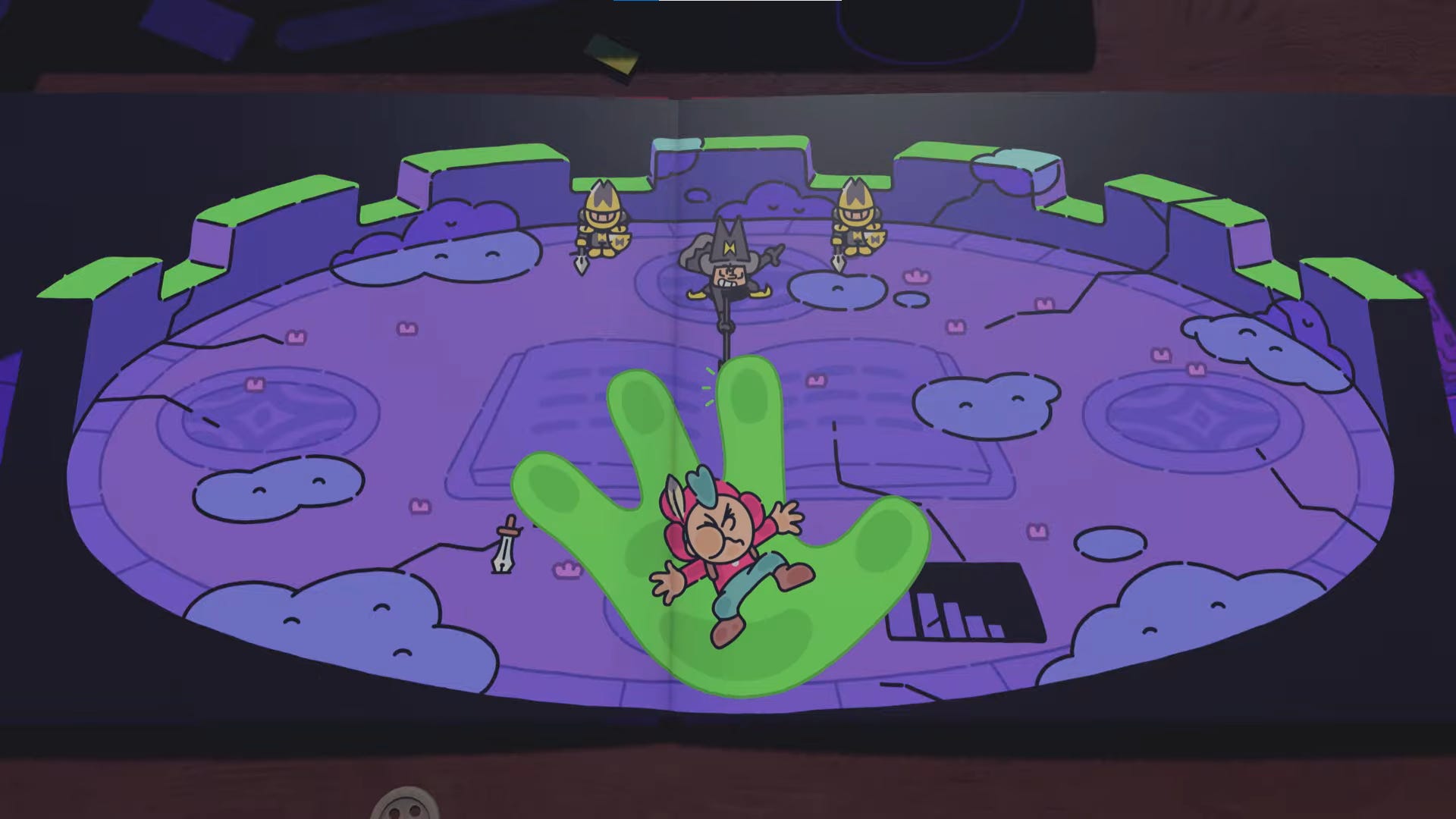
Humgrump says the world they live in is a book, where Jot is the protagonist who always wins, but this time things will be different: this time he will rewrite the story.
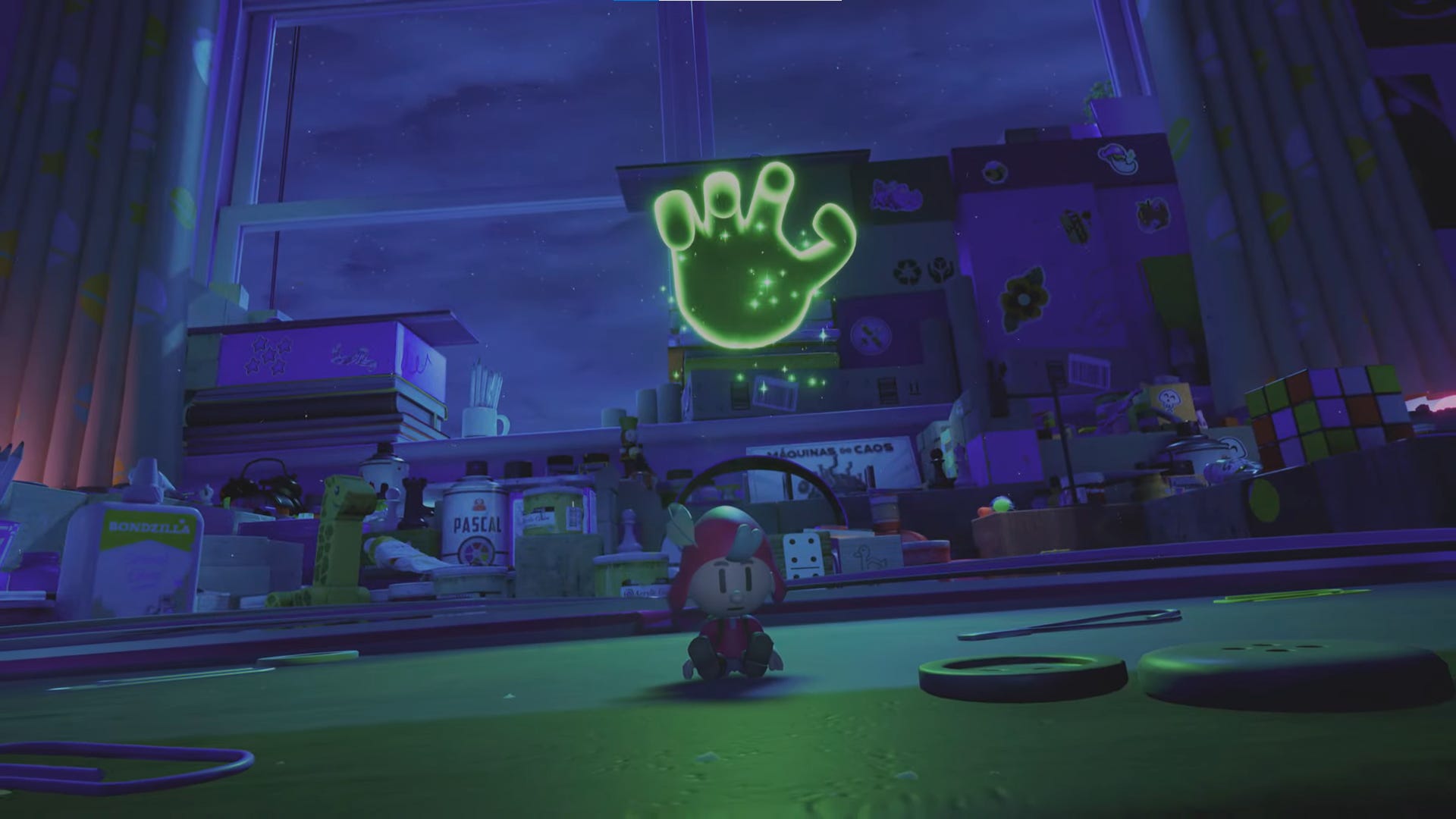
With the book closed, no friends, no equipment and outside his world, Jot sets off on a journey into the unknown. Unexplored dangers and a single goal: get back into the book and stop Humgrump!
This is where the game’s second narrative begins, a narrative beyond Jot, his friends and his enemies. This is the narrative of the “real world”, where the book, on a desk in a bedroom, belongs to Sam, a kid we never get to see throughout the entire game, but who is VERY important to everything’s existence.
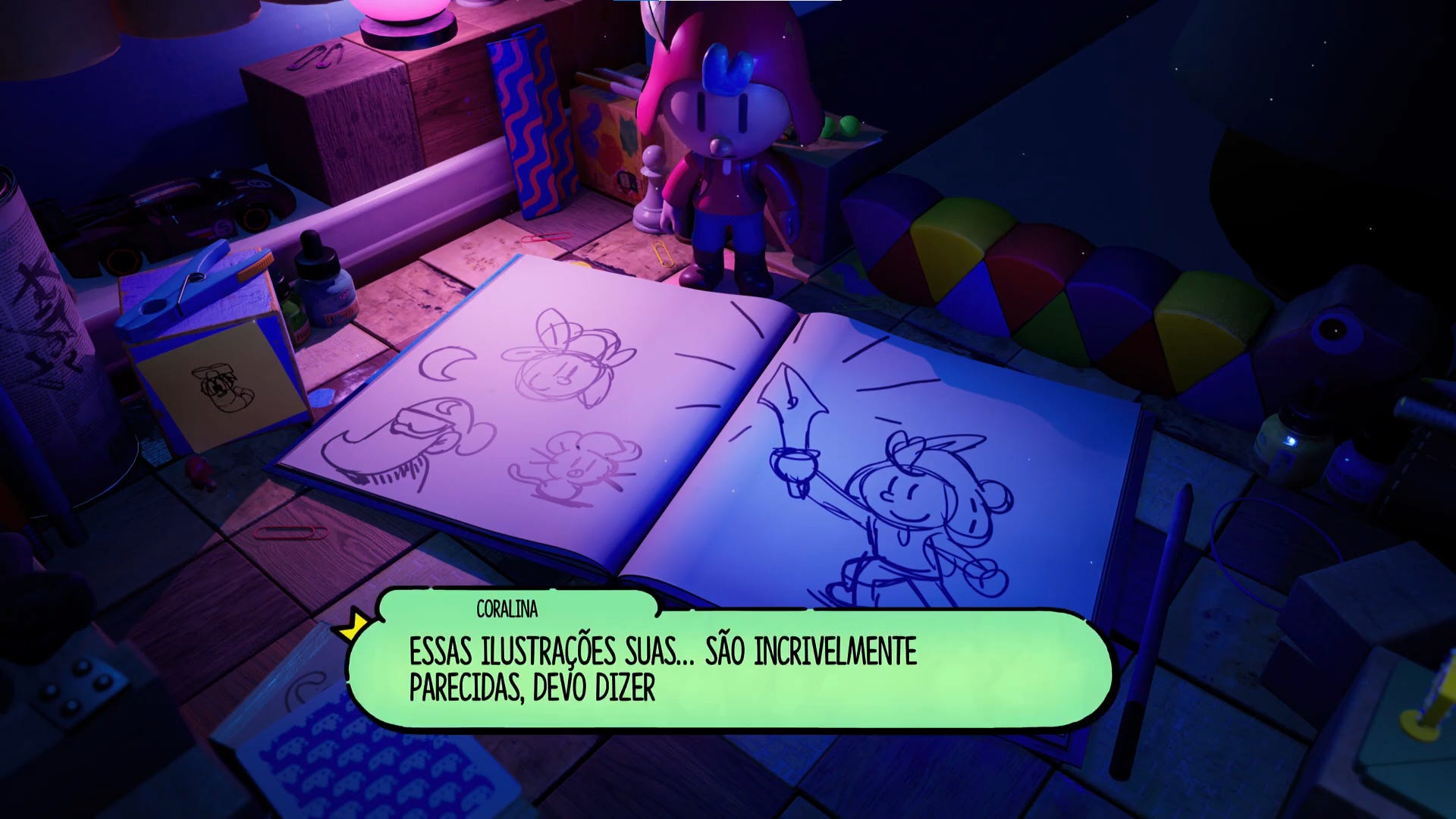
Sam is a very talented boy with a very important future ahead. A bookworm (called Coralina in the Brazilian version) reveals that the future of Jot’s universe depends on how fulfilled Sam will be professionally, with the sales of his first stories, and if they are bad ones, Humgrump’s stories, everything will be different. Sam’s life would be ruined.
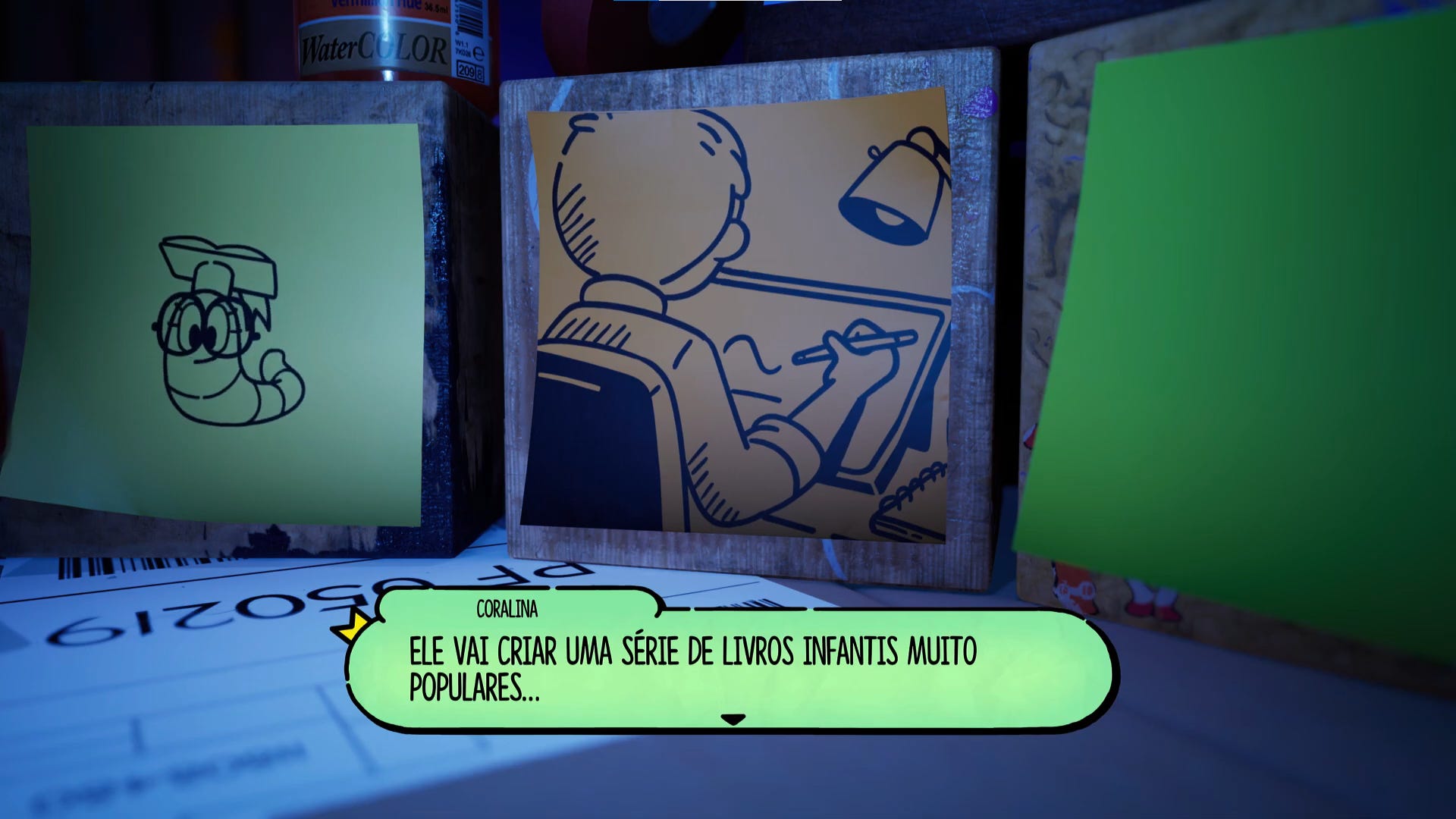
That is how we meet this second narrative line, which, besides being interesting and important, gives us even more to fight for, something beyond our allies’ understanding, and adds an even deeper layer to the game.
Here, the choice of how to deliver this narrative was brilliant. The bookworm is a kind of guide for Jot in the world outside: she points us to objectives and tells us what may or may not happen next. It is a clever way of saying that even your simplest drafts can guide you to a good future.
The important allies
Jot’s allies, Violet and Thrash in particular, are absolutely essential for this game’s narrative to be delivered well. And here the protagonist’s silence comes back into play: while the protagonist is silent, his allies have to be loud, to the point of saying, commenting on and even questioning things you are also saying, commenting on and questioning while you play. All of that creates even more immersion. Violet and Thrash are more than Jot’s friends; they are your friends too, your allies.
I will not go on too long about this, so that whoever plays can be surprised by each character’s own narrative. They go through their own development arcs throughout the game and somehow manage to leave us in doubt at some moments and in their debt at others.
I will only highlight Violet, who apparently started down a villain arc, with hints that she might become a traitor, but in the end turned out to be an even greater hero than expected. Violet once again breaks down the narrative of the decorative heroine and gives the player rich visuals as she fights with her color magic. For a character who could have become a villain, with motivations that echo parts of Humgrump’s origin story, she turns out to be a big surprise in this narrative.
The innovative mechanics
This game’s mechanics are introduced gradually throughout the story. They are almost always items we get outside the books, and often they come from a need to move the story and the game’s objectives forward. To keep this post from getting absurdly long, I will mention only one mechanic that really caught my attention and had far too short an appearance in the gameplay: the bow.
Sure, you will tell me a bow is not an innovative mechanic, since there are countless bows in countless games, but how many of them did you steal from a card (apparently inspired by Magic)?
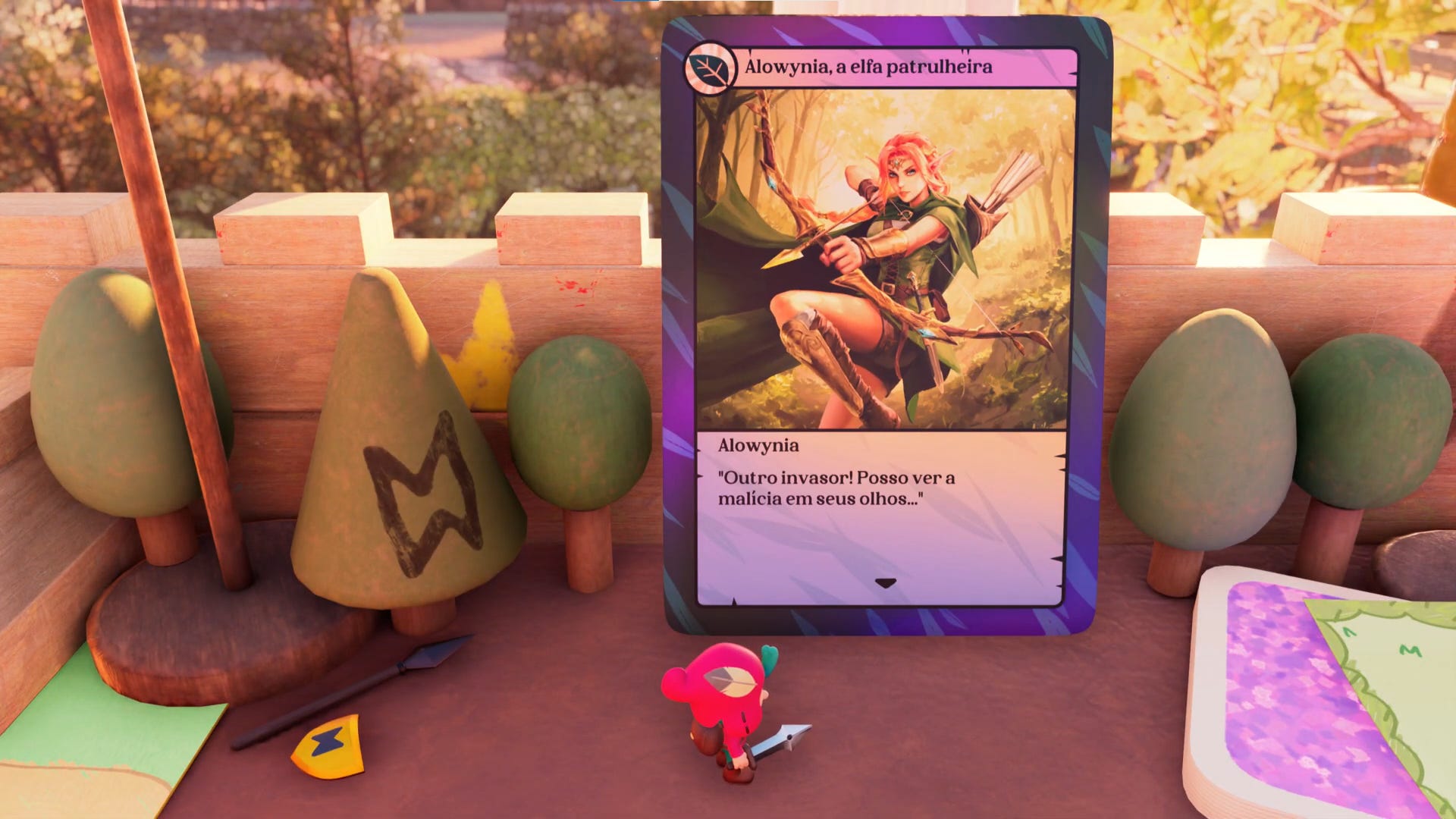
To get the magic bow, we are taken outside the book, where a ranger is keeping watch at the top of “a mountain”. The truth is that the world outside changes according to what Sam is imagining for the adventure, always presenting new levels to explore and new adventures and characters.
This scene is incredible because it is built on a mix of mechanics, narrative and gameplay shifts. To get the bow, you have to go inside the card and fight a turn-based battle in the style of old RPGs. It is probably one of the most unusual moments in the game, and without a doubt a pleasant surprise.
Besides the bow, which we only use for a moment (before it goes back to its owner), there are a few other innovative mechanics I will mention quickly here:
Magic gloves to turn the pages.
Magic gloves to tilt the book.
A stamp that can freeze objects in a scene.
A stamp that can place a bomb in a scene.
Removing and placing words in sentences, changing reality.
And that is just some of the most recurring ones. Imagine puzzles that need 3 or more of these mechanics to be solved, all delivered to the player with plenty of narrative involved.
The end
The game wraps up in a very dark chapter, where Humgrump becomes the story’s new protagonist, but I will not dig into it since it is, obviously, the ending. I strongly recommend you play it to see references to writers, artists and pop culture. In the Brazilian version, all of it is soaked in Brazilian flavor, with Mauro Ramos’s voice and a flawless text localization full of things only we understand.
This game’s story is without a doubt one of the most interesting and wonderful journeys I have had in recent years, and I really wanted to share it with you.
It was precisely because I found this game so “outside the box” that I created my YouTube channel to play, record and share it with everyone. The plan was to post this analysis there, but since nothing went as expected and I felt a bit uncomfortable using my voice and face, I preferred to turn to my usual, familiar, comfortable TEXT. I do not know what future the channel will have yet, but I should decide something soon.
I will conclude by saying that The Plucky Squire was the most fun, colorful and interesting game I played this year, for more reasons than fit in a newsletter, and that narratively it is one of the biggest surprises of the indie world, especially among 2D-3D adventure and platformer games.
And that is what a game should be: fun, above all!
Bonus: The developers’ narrative.
Here is a bonus for those who read to the end (I suspect there will be few of you). This section is about the game’s collectibles. One of them, the scrolls, often hidden in the scenery, is part of a tertiary narrative puzzle few people noticed: a conversation between the developers and you.
Each scroll, when opened, reveals concept art from the project, from characters, settings and levels to items and even monsters, and each one comes with a text from the creators explaining what it is and how it was kept or cut.
These scrolls do not follow an exact chronological order, but they tell a story: the story of people who worked for years on that project and, piece by piece, built one of the most incredible ideas of the recent indie scene, a game that plays between 2D and 3D and, without straining, tells a beautiful story and entertains the player through innovative mechanics and captivating characters.
Tell me in the comments what you thought of this analysis and which other games you would like me to analyze this way here. Thank you so much to everyone who read it, and a big hug!
See you next time, explorers!
Originally published in Prosa & Pixel, on Substack. See it on Substack · Subscribe to Prosa & Pixel · All issues