Warning: the text below contains spoilers for the book reviewed :D
The magic of words is hard to describe, however hard we try. Writing is an art — and, more than that, creating is art, whatever the means. There is something sacred and at the same time unsettling in the act of telling stories, as if we were always on the verge of touching something too old to be named. Maybe that is why, when a work manages to get close to it, we feel it right away.
That is exactly what happened when I first saw the cover of Cantiga dos Novos Bruxos e Outras Artes Proibidas (Song of the New Witches and Other Forbidden Arts).
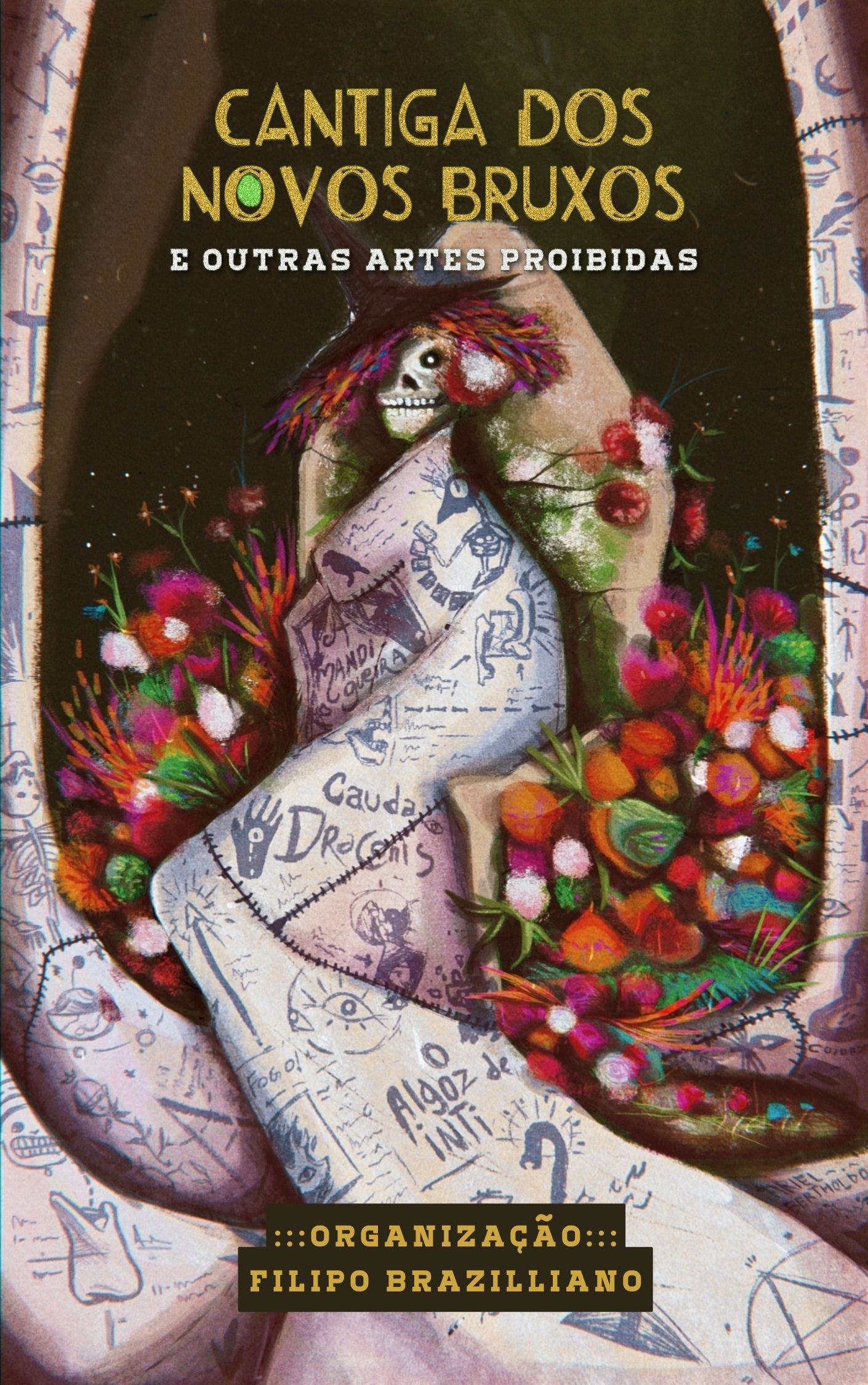
It was the intriguing title, the beautifully composed art and the work as a whole. It is rare, but it happens: the cover won me over before the first line. And that is not common with me. I admit I judge books by their covers — and this one, in particular, beat me easily.
But most importantly, the content delivered. And it delivered well.
The Foreword
The book, published by Perene Editorial and edited by Filipo Braziliano, brings together three stories that set out, each in its own way, to explore the limits of magic, the word and creation. The subtitle “other forbidden arts” is no ornament. It is a guide. As I read, I understood that what binds these texts is precisely this attempt to make writing more than entertainment. Here, it is evocation. Risk. Ancestral debt. And above all, enchantment.
It is a short collection — three stories and a foreword — but nothing here is shallow. On the contrary, each story works with narrative layers that go well beyond the surface. Magic is more than spells or pyrotechnics. Magic here is bond, guilt, power that came before us. And so are words, by the way.
Right in the foreword, signed by J. R. P. Lima, this idea is handled with sensitivity: words do things to us. Literature is understood as a magical, insurgent act. By mentioning Jorge Larrosa, the author invites the reader into a silent pact: whoever reads lives more than one life; whoever writes reassembles chaos. Fortunately, it is no foreword of empty praise for the authors or stories. It is a text that places us right where it matters: writing is also a way to conjure and to break, and maybe that is why so many people fear culture.
Story #1: A Mandingueira (The Spellcaster)
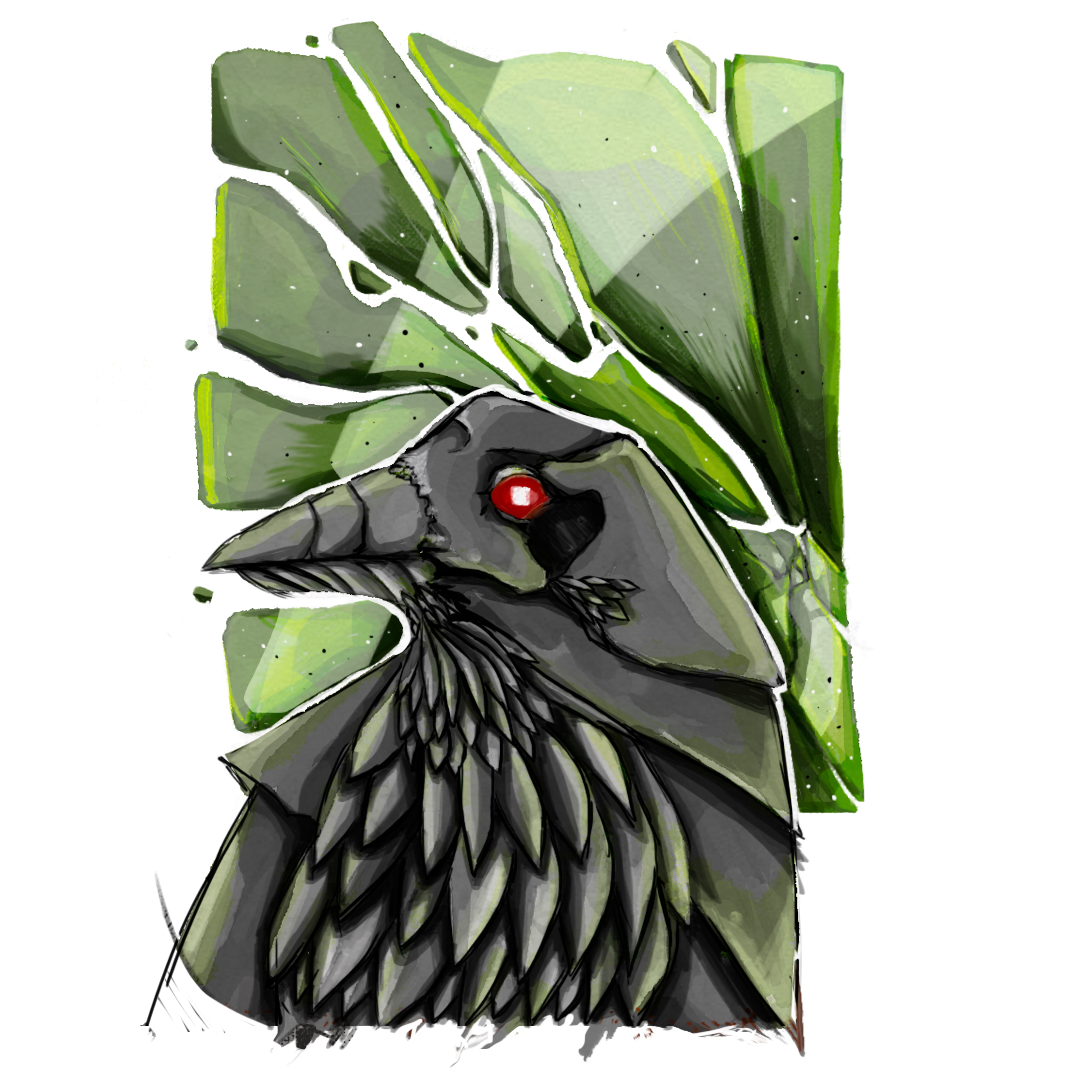
The symbolic gaze we catch in the foreword extends to the first story, “A Mandingueira”, by Mylena Araújo. Here we are thrown into a cycle of death and rebirth marked by an inherited burden: Pedro is the son of a writer — and he pays for it. The curse that haunts him comes from his father’s writing, and the narrative plays with metalanguage as a living curse. The setting moves between the dark and the mythic, in an almost sensory geography where elements like the raven, the cave and the mirror are more than symbols; they are magical devices that drive the plot. Mylena’s writing is lyrical, sometimes even too much, but that does not break the story’s dark spell. On the contrary, it heightens its cyclical, sad nature. The ending offers no resolution — and that is the right call. The magical realism here serves helplessness rather than catharsis.
There is something deeply melancholic in how A Mandingueira is built. Pedro is more than a protagonist trapped by a curse: he is, above all, a son who inherited language as a sentence. The narrative uses fantasy to discuss intergenerational trauma and how hard it is to escape a fate narrated by others — in this case, his writer father. Mylena’s writing echoes that prison: it repeats images, folds symbols, reinforces the circularity of time and space.
The cave, the mirror, the raven, the old woman — all classic archetypes that work as mirrors of a fragmented self.
The most fascinating thing, for me, is how the story ends with no redemption and no escape, as if writing it were part of the spell itself. Mylena writes with restrained anger, like someone who knows that telling stories can be a form of revenge. Or of survival.
About the Author
Mylena Araújo writes dark fantasy and is a future Spanish translator. A lover of villains, she always finds a way to give the antagonist more impact and screen time in her stories. She published her first doorstopper in 2012, Valera — A magia não deve morrer, and in 2014 released the science fiction novel A sombra de um outro mundo on Wattpad, now with more than 35,000 reads. She also published the horror story Não diga seu nome in Revista Perpétua. She loves rain, cold drinks and cats.
Story #2: Cauda Draconis
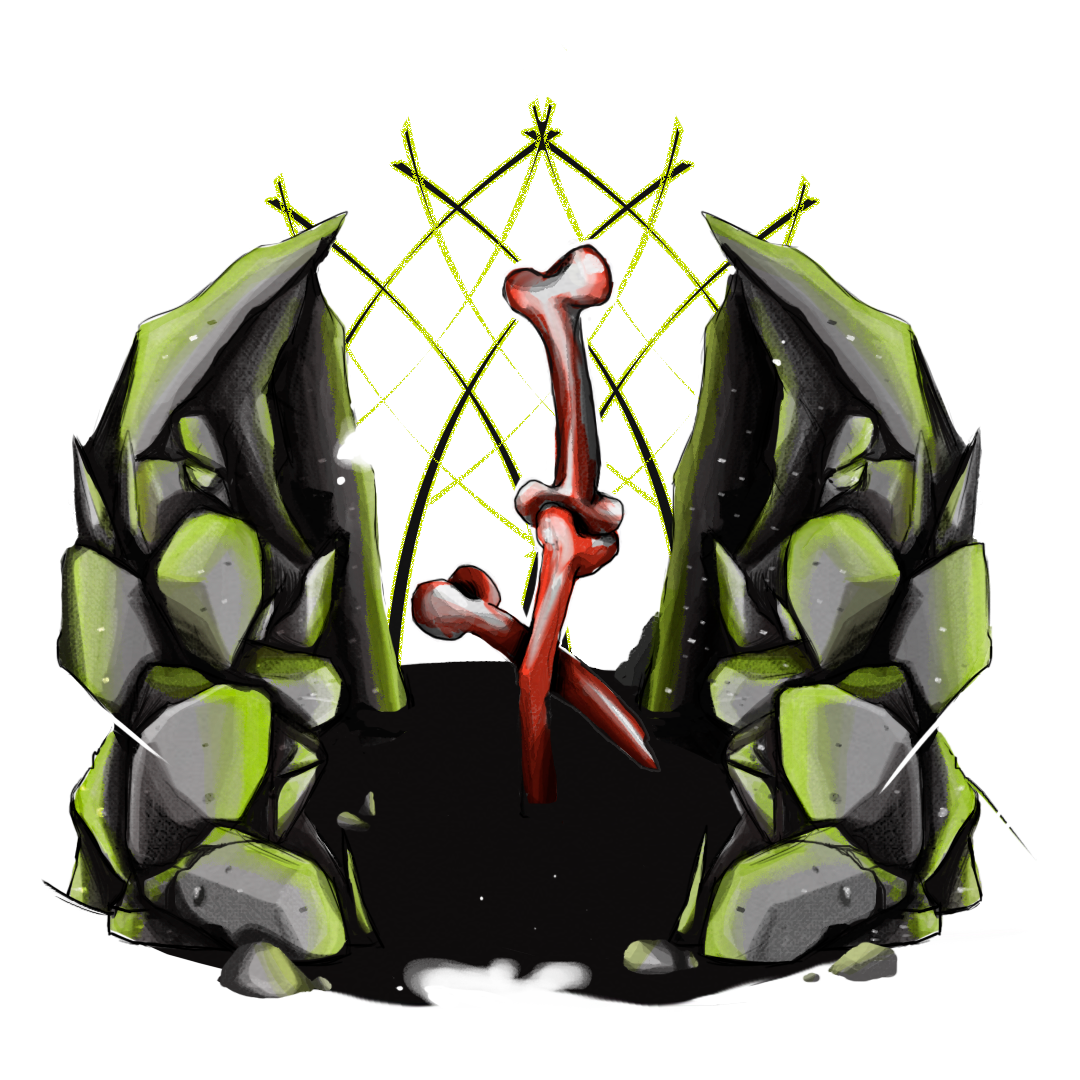
“Cauda Draconis”, by M. P. Neves, changes tone and rhythm, leaning toward a more structured fantasy that feels like a grimoire, a map and a study. The story introduces Godric, a methodical geomancer, and his interaction with an eccentric scapulimancer. Their meeting is almost an allegory of fantasy writing itself: science and intuition, calculation and omen. The mythology of “ley lines” is well explored, and the story gains strength from its dense symbolic grounding. In the end we find out that what looked like rock was bone, and that the old guide was the real necromancer. Even with its occasional excess of exposition, the text leads us to a moment of apocalyptic revelation worthy of a good cosmic horror story. In tone and structure it reminded me of certain moments in The King in Yellow, or even something of The Broken Earth by N. K. Jemisin, especially in how the ruined world mirrors the rupture of the magical flows themselves.
Neves offers a story that, in its structure and vocabulary, flirts with the occult essay. Reading Cauda Draconis is like opening an ancient manuscript and trying to decipher an equation written in magic and telluric logic.
Choosing a geomancer as the protagonist already breaks the cliché of the wizard-hero and places us in a narrative where knowledge matters more than strength.
The clash with the scapulimancer, young and intuitive, suggests a generational conflict within magic itself — empirical knowledge versus chaotic intuition. It is also a story about arrogance: that of someone who believes they master the forces of the Earth without understanding it. The ending, grand and sinister, flips the game. Necromancy wins. The guide turns out to be the real sorcerer. The “stones” are bones. It is as if the author were saying: no science can withstand the weight of what lies buried.
About the Author
M. P. Neves is a civil servant who writes fantasy and horror. He has read so many fantastic stories that he no longer lives entirely in this world. He is the author of the trilogy A Ruína de Noltora and the illustrated collection Relatos da Ruína, published by Editora Virafolha (PE). He likes everything that enchants and disturbs, and tries to bring that same uncanny fascination to his books.
Story #3: O Algoz de Inti (Inti’s Executioner)
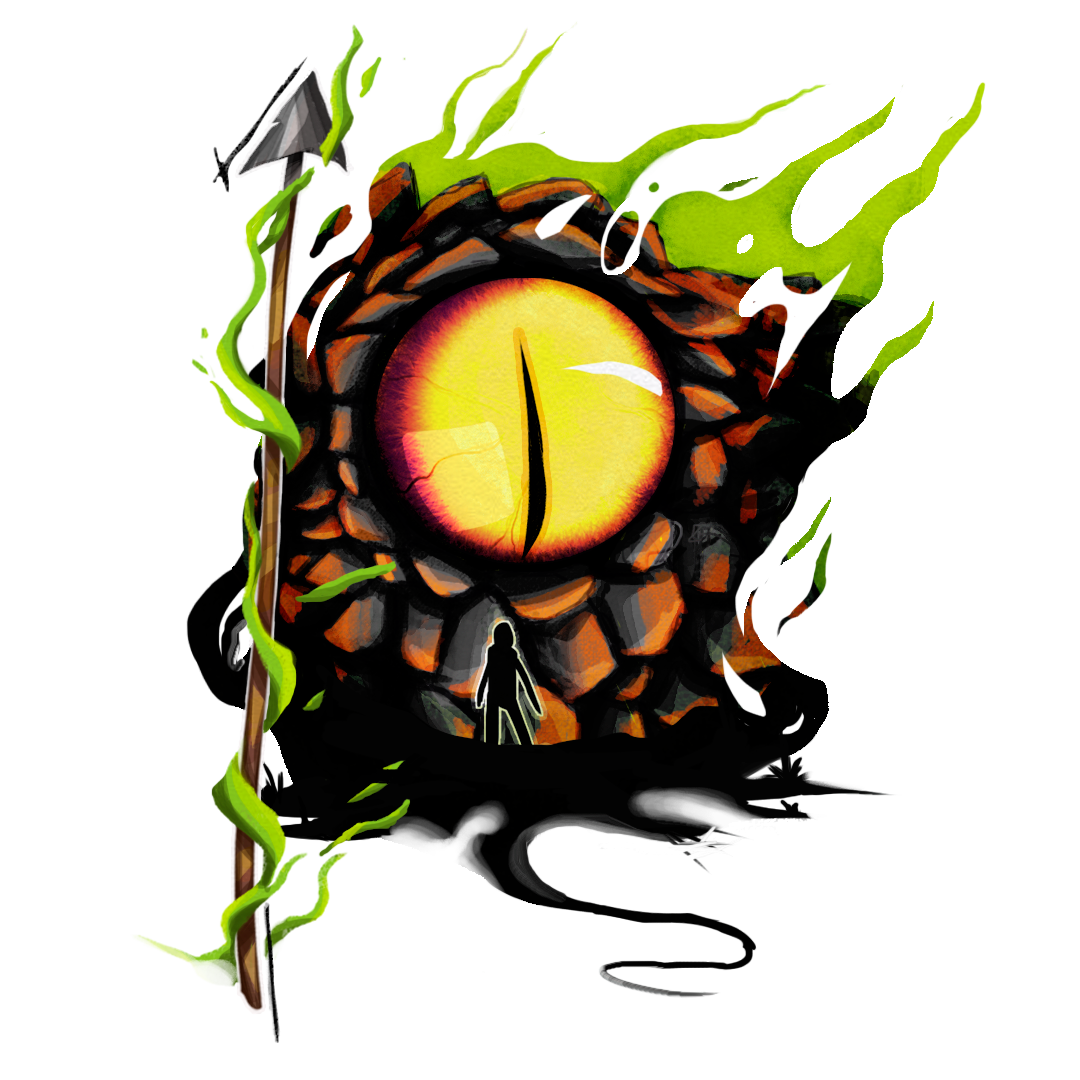
The third and final story, “O Algoz de Inti”, by Mateus Cantele, is the most adventurous — and maybe the most pop — of the three. That does not make it any less. Savannah Rogers is a hammy protagonist who could have walked straight out of a Latin American steampunk anime. The text mixes pyramids, traps, mythological serpents and pyromancy as if they were ingredients of a dish that has to be served fast, hot and vibrant. And it works. Using Inca mythology as the backbone of the narrative is a smart, refreshing choice that takes the plot away from the tired Celtic and Norse universes of standard fantasy. The ending, in which Savannah is reborn after a personal sacrifice, nicely evokes the archetype of the “hero’s symbolic death” and closes the cycle on a bittersweet note. He does not reach the retirement he was promised, but he rekindles the flame within. A pun? Maybe. A well-built metaphor? Without a doubt.
Savannah Rogers is the kind of character who reminds us that fantasy can also be fun and full of adrenaline. But Mateus Cantele’s story is more than a charismatic raider facing a mythological serpent. There is a strong emotional layer there, kept in silence: the letter in his pocket, the swallow, the idea that every theft hides a longing.
Pyromancy as a gift that slowly consumes its user is a brilliant idea: the more Rogers uses his power, the older he gets — and that struck me as a direct metaphor for the price of artistic creation, for overusing your own inner flame.
The Andean setting and the mythological choice avoid the obvious and make the text even more powerful. The hero who is reborn young at the end, but has no time to lose, perfectly sums up the archetype of the warrior doomed to always set out again.
About the Author
Mateus Cantele is a writer and history teacher. A compulsive creator, he found in writing the space he needed to give his creativity wings. He has published stories in Tokyo Defender, Faísca Mafagafo (@mafagaforevista), Revista Perpétua and Pulpa from Escambau Editora (@escambaueditora). He published his first novel, Apóstolo de Maria, in 2022, and publishes the light novel SENAB – Serviço Nacional de Benzedeiros every two weeks on Wattpad. He loves challenging his writing with crazy ideas and hopes the universe does not destroy him before he finishes his next novel.
Conclusion
What catches my attention in this anthology — and what earns it a place on the shelf of anyone interested in fantasy made with soul and intent — is the diversity of styles and approaches, but also the point of contact that unites them: every story deals, in its own way, with the ancestry of the word. With the weight of language as inheritance, curse, knowledge and salvation.
You can trace a thread that runs from A Mandingueira to Cauda Draconis and flows into O Algoz de Inti. Each story is about someone trying to decipher a riddle bigger than themselves. A son, a wizard, a thief. All of them face a past that insists on writing the present. All of them touch something forbidden, whether a mirror of past lives, a tower made of bones or an enchanted spear. And all of them pay a price.
In the end, Cantiga dos Novos Bruxos seems a spot-on title to me. These authors really are new witches, and their arts are indeed “forbidden”: for straying from the norm, for daring to tell myth in another key, for writing with anger, with loss, with a hunger for the world.
I recommend it to anyone who wants to feel fantasy as more than an escape. Here, it is debt. It is a map. And it is also fire.
See you, explorers!
Originally published in Prosa & Pixel, on Substack. See it on Substack · Subscribe to Prosa & Pixel · All issues