FINALLY, the sequel. I thought it would take less time to post, but here we are.
I remember writing this story. One fun fact about it: it was written well before “I Surrender”, and after a while I had to adapt it to fit better with the previous one. I like the idea that they have continuity, even though they can be read on their own.
Here I wanted to explore a different feeling from the last one, a feeling I have had and admit I still have on strange days: discomfort in your own form. Feeling uncomfortable for having arms, legs and a head, for walking the way you walk, breathing and speaking the way everyone does; a discomfort in being human, in carrying this carcass of meat, skin and fat, filled with organs… everywhere.
Besides that, here I tell an idea I came across in some book I read as a child. I do not remember its name, but it is a simple idea that, well explored, can yield good stories: the encounter with the unknown. You can sum it up in a basic question that can guide any story, and it works as an exercise too.
“What would you do if you found something in a forest you had never seen, heard of or imagined?”
Enjoy the read!
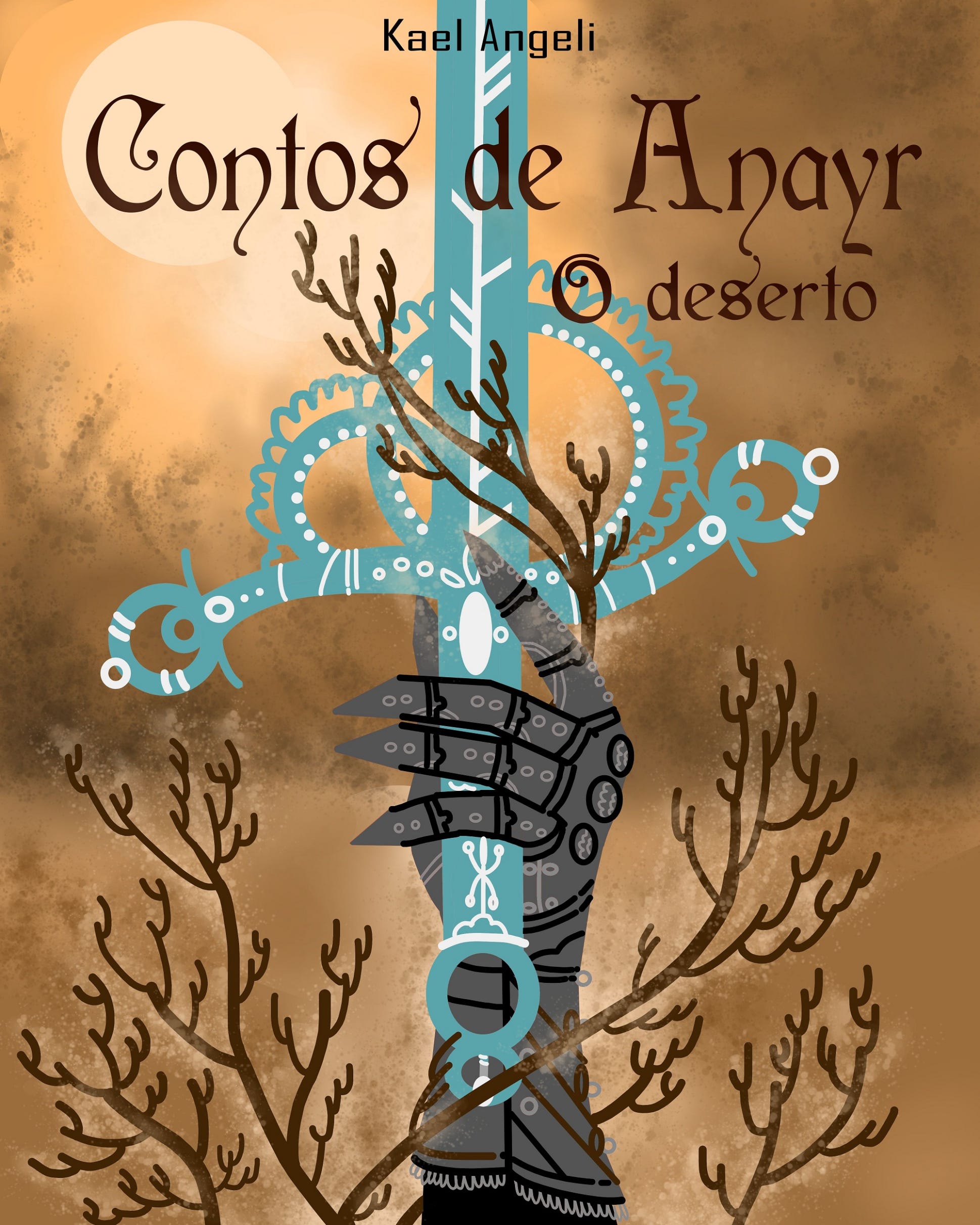
Reborn from the Sands
He had opened his eyes. He was conscious again, with no memories, locked away, but where? His vision was blurry, scrambled. It was hot, and his body was curled up. He tried to move what should have been his arms, but his body was not the way he felt it should be. He stretched, and it was like expanding in every direction. The sound of something cracking and then breaking was followed by sand falling over his body. He dug and dug, frantically. He saw the first rays of sunlight.
He rose with great difficulty. He was in a desert, a vast, immense desert, and his blurred vision could barely see how far the dunes stretched. He had just come out of what seemed to be an egg. He was covered in slime; it must have stunk, but he smelled nothing. He looked carefully at his body. It was not what he thought it should be; his mind was not wired for that. His lower half was still buried in the sand of the dune, but he could feel what must have been six legs. His whole body was covered by a carapace, a firm, tough exoskeleton, ugly and deformed, yet light. What he felt as two arms were in fact claws.
An enormous sadness flooded his mind, his heart. He wanted to cry and scream, but his mouth was nothing but mandibles, like an ant’s. No tears ran from his eyes, and his voice was shrill and horrid, producing nothing but noises and unintelligible shrieks. He turned his torso to look around. He needed to stay calm and try to understand what was happening; he needed to find a familiar face, someone, somewhere. He needed to understand his feelings. His head ached as if something were missing from his mind. Worse than all of this was the instinct telling him to flee, run, hide, cry for help. The desert was not his home.
He blinked, tried to move his buried legs, and it was as if the desert itself helped him walk on the sand. He walked a little, trying to get used to his new legs and ignoring the mental despair. His body was clumsy and his movements too fast; it took him some time to walk with any precision. He closed his eyes for a moment, tried to calm down, think clearly, plan, or maybe remember something. And it was with his eyes closed that a light came to his mind, like a map. In his mind, it was as if he knew by sheer instinct every border of the desert. Now he knew which directions to take to get out, he knew where bodies lay buried, and of course, where more of his own kind were.
He followed his greatest desire at that moment, to escape. He needed to leave the desert; only then could he keep his mind quiet and maybe remember how he had ended up there and why that form felt so strange to him. He set off. The heat created illusions and warped the shapes of the dunes ahead, but it did not trouble his carapace, did not trouble his walk; it was as if this were the ideal climate. His steps grew faster, his instincts clearer, the dunes smaller. The desert was not his home, but it was his ally. He could feel it.
The creature walked without stopping, and night came, then day again, many times. It was as if time could not be felt; he only saw the sky change color, stars setting, the sun rising, the moon appearing, and so on, and neither hunger nor thirst wore him down. He felt as if he had been designed for that kind of extreme situation. He walked and walked, until from the top of a dune he could see the end of the desert on the horizon. The desert ended like a sea, washing against a green, grassy plain. His head hurt as he looked at it, as if the place were important, but he did not know why. Some memory lived there, but he could not reach it. Strong wind, sandstorm, screams. He could not remember.
When he reached the grassy plain, the creature felt cold. His urge to flee had calmed, but hunger and thirst struck him all at once, as if they had piled up over many days. When night fell his body had already adjusted to the temperature, but he was weak and could barely walk, and he staggered on until dawn. His vision, which had been adjusting, blurred again. He was dizzy, and all he could see ahead was still an empty plain, lots of grass, few trees and no road.
He walked for a few hours, still stumbling, until he found a river. It was night once more. He stopped and drank some of the water like a dog, sticking his face right in. On the horizon ahead there were now mountains. Had they been there before? He followed the river until dawn, then spotted a grove at the foot of the mountains. There were bushes and small trees, and he thought he might find fruit; if he did not, he would eat the leaves. He had reached the end of his strength. In all, it had been almost 3 days of walking across the plain to the grove.
The grove was welcoming in every way. As he entered, the creature felt a fresh breeze on his face. There were bushes and flowers all over the grove, grassy ground and trees wrapped in climbing plants. He did not have to walk far before spotting small animals, squirrels, birds, and with the last of his strength he found apple trees laden with ripe, delicious fruit. He managed to grab a branch with his strange arm and tore it off without much effort. He ate the fruit, the leaves, and nearly gnawed the branch, until the song of distant birds caught his attention.
He closed his eyes. The beautiful birdsong seemed to stir some feeling in him, one he did not understand and could not grasp no matter how hard he tried. He let himself sink onto the grass for a while and felt tiny ants walking over his head. He almost fell asleep, but thirst came back to torment him. His strength was nearly restored, so he decided to go back to the river he had followed. He got up after resting for some time, tried to walk again and managed it; he had almost fully mastered the strange body.
He walked along small trails. He passed plants he did not know or did not remember. He passed trees. He was startled by wild rats and boars, but he always sent them running, as if he were a monster. And judging by his appearance, he knew he was.
An immense sadness had haunted him ever since he woke in the desert, but that day he felt it more intensely. It was as if he truly would rather be torn to pieces than live like that. Above all, he felt it was not natural; it should not be like this, it was wrong. Everything was wrong. He tried to punch trees, but he had no hands. He tried to scream, to dig and bury himself; he tried everything to hurt himself. He wanted to die. He beat his head against sharp branches, against rocks, against the ground, but nothing wounded him, no one heard him. There was no peace. He had even forgotten his thirst amid so much sorrow.
After suffering a long time in his prison without walls, he listened carefully to the sound of running water and followed it until he found the river again. It was narrower there, a small stream of crystal-clear water, and what he saw on its bank was astonishing, like a dream come true. In that moment he discovered joy. A man. The young man wore chainmail, greaves and gauntlets, and knelt with a sheathed sword at his waist. On his knees, he was drawing water from the stream with a bucket; beside him, another wooden bucket was already full. The creature needed to get closer, to try to communicate.
He ran toward the young man, who was now standing with a bucket of water in each hand. Seeing the monster approach, the warrior dropped the buckets and clumsily drew his sword. His face showed shock and fear, but he did not let the fright shake him. He attacked with a quick downward slash, opening the fight without advancing. The creature pulled back, dodging the blow, then leapt backward on its strong legs, planted itself on the ground and did not move again.
“Don’t move! Hideous monster!” the warrior shouted, his voice firm. Beneath his blue-crested helmet, his gaze was intimidating and fearful at the same time, as if warning he was ready to die fighting.
The bushes behind the warrior rustled, and with the sound of dry leaves snapping, two more men appeared. They wore gear similar to that of the man with the drawn sword. The newcomers drew their weapons and prepared for battle.
“Why isn’t it attacking?” asked one of them, the one who seemed most frightened but was the biggest of the three.
“It doesn’t look hostile, it isn’t even moving!” said the one who had already attacked.
“It’s like a snake, don’t you see? It’s waiting for one of us to drop our guard so it can strike!” said the third.
“Did you bring capture nets?” one of them asked.
“No...” answered the tallest.
“I want to take it alive so the commander can see the absurd things still living in this grove.” The young man who had been fetching water now seemed bolder; his comrades’ presence and moral support made all the difference.
The creature understood what the men were saying. It understood they wanted to capture it, and it understood that if it attacked, it would die. It wanted to speak, but if it tried, it would only sound like a scream of horror, which would cause fear, and then it would be attacked. It shook its head, as if to say there was no way out, and tried to fold its four legs, as if kneeling. “I surrender,” it thought.
One of the men, the tallest, the most fearful, stepped forward, shouted and raised his sword. The creature closed its eyes and felt a screaming pain as the blade struck its face. It did not cut, but it was like a mighty hammer slamming into its head. It all happened very fast. Far worse than the branches and rocks it had used earlier in search of a liberating death. It opened its eyes and screamed in pain until its vision failed and it passed out, filling those present with fear and horror. The young man who had struck it stood open-mouthed, surprised at what he had managed to do.
Ͽ۞Ͼ
Water on his face; a little got into his “mouth”. He woke and tried to get up, but could not; his legs were chained. He looked around with difficulty. He was in a cage. He could not even have stood up if he had been able to. Outside it was a bit dark, lit only by an oil lamp in a corner. The ceiling was canvas, and near the cage there was a table with a few chairs. On the table there was a bottle and cups, some rolled-up scrolls and a sheathed sword. The one who had thrown water on his face stood in front of the cage. He was just a man without armor, dressed in leather, with a serious expression. He picked up the bucket he had used and left through an opening diagonal to the cage.
After the man left, two others came in. He recognized one of them at once: the young warrior who had been fetching water from the stream. The other wore splint armor, the metal dyed a scarlet tone, and a bluish cape fell almost to the floor from his back. There was no sword at his waist; the sword on the table was probably his. He carried himself with authority.
“So this is the damned creature you and your comrades found in the grove?” The man in the cape crouched for a better look, and the creature shrieked.
“Yes, my lord. I was getting water from the stream with buckets when it approached. Two comrades and I managed to capture it alive.” The young man briefly recounted the facts. His superior, crouching, studied the creature, careful not to get too close. His face showed disgust.
“Where do you think this hideous monster came from?” the man asked, standing again and spitting into a corner, as if nauseated.
“We examined it when it passed out. Its lower legs, like its body, were covered in a layer of very fine sand. We believe it came from the great desert, my lord.” Those words seemed to pierce his superior’s mind like knives.
“You did well to bring me this monster. You and your comrades will be rewarded for this act of courage.” He touched the young man’s shoulder. “Sit down. Let me tell you something.”
The young man pulled up a chair and sat. The creature watched everything closely, but something greater than its survival instincts was calming its soul. It was as if the place itself were starting to make sense, as if the glow of the torch and the sound of those men’s voices were familiar, as if their accent should be its accent too. And when the man in the cape took the sword from the table and fastened it at his waist, that last sound made him remember a word, and it made sense. It was more than a word; it was a feeling. Home.
“Young man, a few months ago I was appointed commander of this small scouting and hunting troop. You saw me arrive, and no soldier ever asked where I came from or why I was promoted. Now I will let you know.” He took the bottle from the table and poured wine into two cups. “I was part of a larger troop, one that ventured beyond the groves. We wanted to make history. We marched beyond the desert terraces, and that is how we failed. You know what lies beyond those cursed plains, don’t you?” he asked, taking a sip.
“Yes, sir. Beyond the terraces lies the desert itself, impassable since... forever.” The young man answered, taking his cup and drinking the wine while staring at the creature in the cage.
“That’s right, boy. We know a lot about Anayr, our continent, but not all of it. We know what the maps tell us, and the maps are made by troops like ours. To the North we have the frozen forest, Belian, surrounded by small villages and a frozen kingdom, Glésias. Our ally.” He had now unrolled one of the scrolls on the table and was pointing at locations on the map. “Here we have Venair, the sacred forest. Further on, over there, in the luminous forest, we have Lúria, the trading city that marks the border between our side of Anayr and the side of the Lumárens, the oldest people in this world. And look, here, this is Lumária, the homeland of the Lumárens, children of the moon. We do not know much about their side of the continent, but we know of some small kingdoms and villages there too.” He went on, pointing at places on the map. “And here, son, we have Lyane, close to where we are. Our home. It is said that somewhere in the seas lies Ilianor, the capital of the Numari, but that one does not matter to us for now.”
These were not all the known places of Anayr, but the young man was following.
“All of this is part of northern Anayr,” the boy added, watching his superior drink a little more wine. “In the South, by ship, there are some other kingdoms, like Garcet and Núzen. You have to go by ship because the great desert cuts our continent in half.”
“Yes. Going down the map, heading south from here, are the desert terraces, which, as everyone knows, are the plains before the great desert, the cursed desert. No one knows that place; few expeditions have dared to enter it.” He paused, took a deep breath and spoke again. “Mine was one of those that got very close to its sands, but we were swallowed by an endless storm, and I was the only survivor!” He slowly pounded the table. “That is how I earned the post of commander of Lyane’s twenty-seventh scouting and hunting troop.”
“That is impressive, sir, but with all due respect, where would this creature fit into your story?” the young man asked, after hearing everything.
“I never found out what happened to the rest of my squad on that lost expedition. I never saw them again. And if you are now telling me this creature may have come from the desert, can I then say this is what my comrades fought against?” As he asked this, he turned a cold, angry gaze to the creature in the cage.
That gaze, that voice, that story: suddenly things became clearer. Some memories came back, and the creature needed to say something. It shrieked and shrieked, but nothing came out. It thrashed, trying to break free. It needed to speak to the man in the cape, but how? How could it tell him about the desert, about the creatures? About how it worked, about how the sands helped the monsters that lived there? It shrieked twice more, until the strong man kicked the cage, threw wine in the monster’s face and shouted:
“I will wipe out your wretched kind!”
The taste of the wine was crucial. In the blink of an eye, he regained all his memory.
“Vaaaaliiiirrrrr,” he managed to say, in a shrill, horrid voice.
The man in the cape dropped his cup and fell to his knees before the cage, eyes wide.
“Why did you say that name?!” he shouted, pounding the metal bars. The young man who had watched everything touched his superior’s shoulder in a gesture of sympathy and support. “He said the name of a comrade from the expedition! Did you hear it?”
The young man let go of his shoulder and kept calm.
“Yes, sir. I heard…”
“We need to communicate with this monster! Now!”
I admit I deeply admire my writing in this story. It is much more mature, and it surprises me that I did not reach the same level in “I Surrender”, which I wrote a few days after this one. It is funny: early adulthood is full of moments of inspiration and coherence where, for a second, things make sense and you manage incredible feats, feats that turn out strange when you try to repeat them…
I tried to repeat this level of writing in 30 other Tales of Anayr. Some came out good, others not so much. The thing is, good ideas come and go, but well-told ideas are much rarer. The art of telling is far more complex, and it needs to be aligned with the art of writing; otherwise all you have are piles of sentences and paragraphs that make no sense or have no spark.
I should post the last part soon, the longest one. I hope you enjoy it.
See you, explorers!
Originally published in Prosa & Pixel, on Substack. See it on Substack · Subscribe to Prosa & Pixel · All issues