When I was 14, I teamed up with a schoolmate and we tried to make comics. Back then I believed having the right materials was the real secret of the craft. I was wrong. There was no big difference between having a notebook or a laptop to write the scripts, as long as the artist could understand and draw them. Nor was there a huge difference between the artist, my friend, using professional or cheap pens. Not even the dip pen (which I swore was something amazing for drawing) managed to get us to release a comic.
Over time, releasing a comic became a very distant dream. Suddenly my friend did not even want to draw anymore, and I only wanted to write things that could be published on Wattpad, Spirit and even Nyah Fanfiction. The idea of having my own comic slowly died.
But, after all, do ideas die?
Learning to write comics
When you are 14 and dream of making comics, the script format barely matters. How the script is organized matters much less than the artist sitting there with you understanding what you mean and turning it into drawings. I was like that for a while, until I asked myself “hey, how are Marvel and DC comics written?”, and my curiosity led me down a few alleys of the internet.
A few PDFs later, I already felt ready to reinvent comics and bring out a new way of writing them. Little did I know that the way I was thinking of writing them was the same way many other writers had thought of before. And they failed. Others succeeded, but it took much more than script formatting; it took more than luck, contacts, money, friends… yes, making comics is more than sitting your butt in a chair and choosing what to create. I know that well.
My learning went from reading PDFs to books I found in used bookstores, bookshops and later online. I took one or two courses that were not that revealing, and I did exercises nobody assigned me, because I thought “this will be a great exercise”. In an earlier post I talked a bit about this process and recommended study materials, so I will not repeat myself here, but one book that really changed how I write comics was Words for Pictures, by the famous Brian Michael Bendis.
Oh, and so you do not leave here with nothing to do, the exercise that best developed my comic writing is not in the book I mentioned. It is very simple:
Open your favorite comic and open a notebook (I always work better with notebooks). Now do the reverse of the comic’s creation process. Write the script panel by panel, looking at them, reading them. Describe the scenes, note the speech balloons, the caption boxes, everything.
Then, with the script you wrote and the art beside it, compare. So, is your text enough to picture all that art if it did not exist? If so, GOOD JOB!
Working in comics
My studies did not lead me to any job; after all, they were solitary studies without much practical application. But when I had the chance, I made it clear to anyone who showed up: I know how to write comics. Did I? Maybe. If I tried, I would find out. After all, no amount of study prepares you for the job market, especially the comics market.
My first job in comics was abroad. I had that luck, or bad luck, depending on how you look at it. I wrote more than 100 scripts for a Texas company that was starting out in comics, with the idea of competing with the famous, gigantic Webtoon. Most of the scripts I wrote were produced, because besides writing I also coordinated a team of five artists. Come to think of it, I think my bosses did not see writing as the real work of the role, which is why I was also a team manager. That is almost cruel, but I was well paid.
That story did not end well. The project was paused, then shut down, because the investment was too high for a slow and very uncertain return. Everyone was laid off and those comics never saw the light of day. You know, it is really sad when you work on something that never sees the light of day; it almost feels like you wasted time. A lot of time. And suddenly, unemployment. It is desperate at first and depressing afterward. My team, the artists, counted on me; they thought I would find a solution to this “crisis”, but it was no crisis, it was the end of the dream of “working in comics”.
And for a while it was hard. I went through a huge personal crisis, doubted myself, and ended up deleting a lot of things nobody ever saw, script after script. Then one day I woke up to an email. It felt like something out of a movie: some “madman” had found me on Fiverr, the freelance services platform.

That was the email that changed everything.
Andrej Biasic and his comics
Imagine that, unemployed, you go to sleep with no idea how you will pay rent at the end of the month, and then, out of nowhere, someone comes up to you and says: “Hi, I’m Andrej Biasic, and I need to create a multiverse of superhero teams. Want to be my writer?”. At first I thought “Oh, why not?” and then “wait, who in this world is called Andrej Biasic?” All of that was followed by doubts about my potential as a writer and, above all, fear: fear of not being enough, of once again entering a spiral of tireless work and minimal results.
Little by little I found out Andrej was the pen name of a really nice guy, a guy with more dreams than me, because time had given him that, and of course he wanted to make those dreams come true. I could help, criticize, or simply do my part and jump ship. I chose to stay, stay and give my best. And that is what I did. With Andrej I have written more than 120 comic scripts (if I did not lose count) over more than a year and a half so far, and we are finally reaping some of the fruit. Of course, the fruit is not always financial, as in this case, but we will get there.
Today I came here to show you some of the stories I made with Andrej. First let us look at the covers, then some pages and their scripts, and finally, a request. Here we go. I have a universe of ideas to show you, good ideas.
Terra Valente Presents
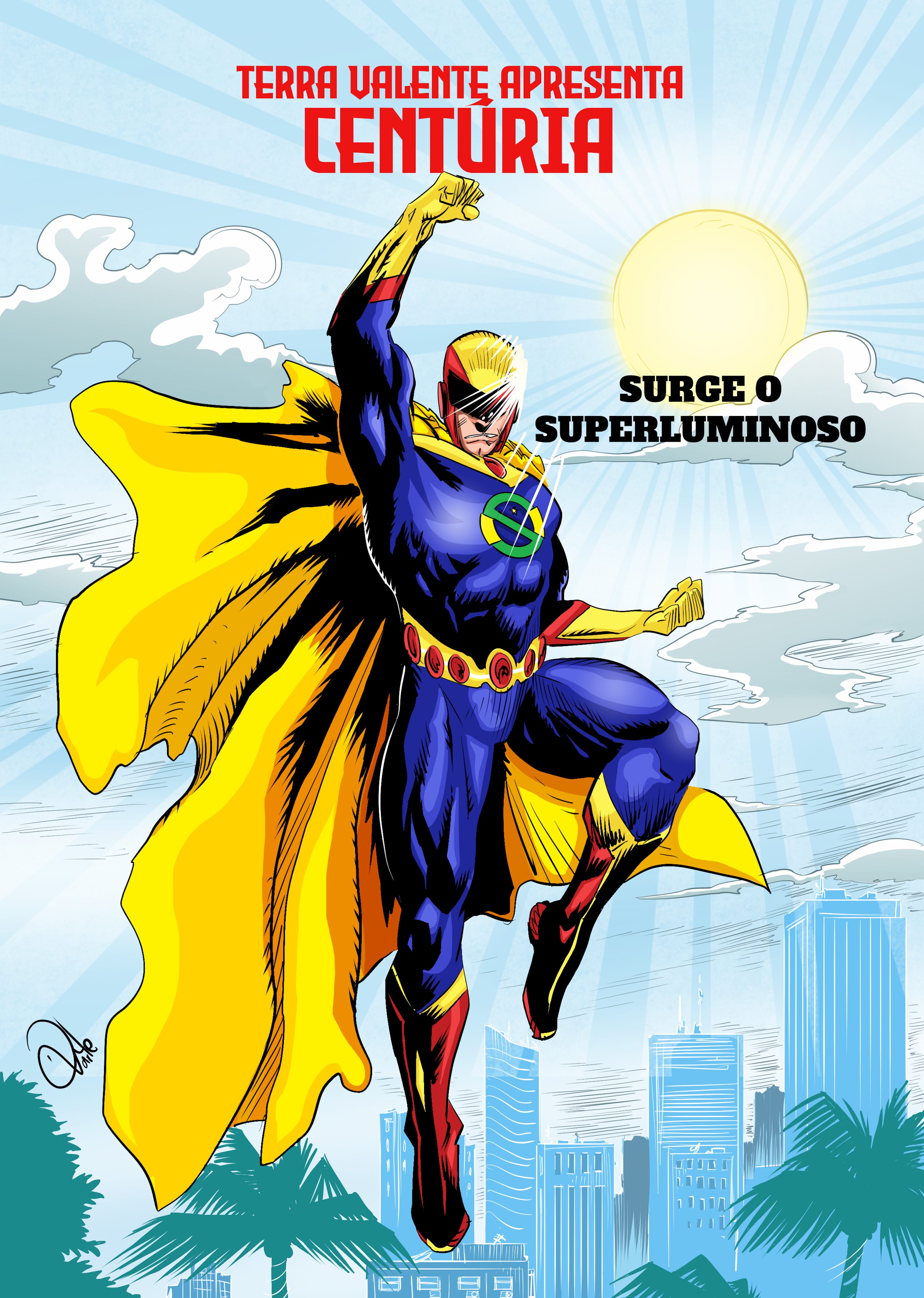
This was the first story Andrej asked me to read, and I will never forget how amazing I thought the idea was. A Brazilian superhero with such an intriguing origin needed a script just as good, and I wrote it. Synopsis below.
The Superluminous Rises: "The Superluminous Rises" follows Alexandre, a Brazilian Air Force officer sent to investigate UFO sightings in his hometown, Colares. During the mysterious Operation Saucer, his return to the small town sets off events beyond human understanding. Amid extraterrestrial secrets, Alexandre becomes the catalyst for a new era of heroes and villains, marking the beginning of Centúria and launching an epic narrative that will redefine the destiny of the Brazilian people.
If that did not interest you, I do not know what will. Let us look at a page from this comic and then its script, so you, if you are interested in writing comics, can compare and use it as study material. Go ahead, you have my permission.
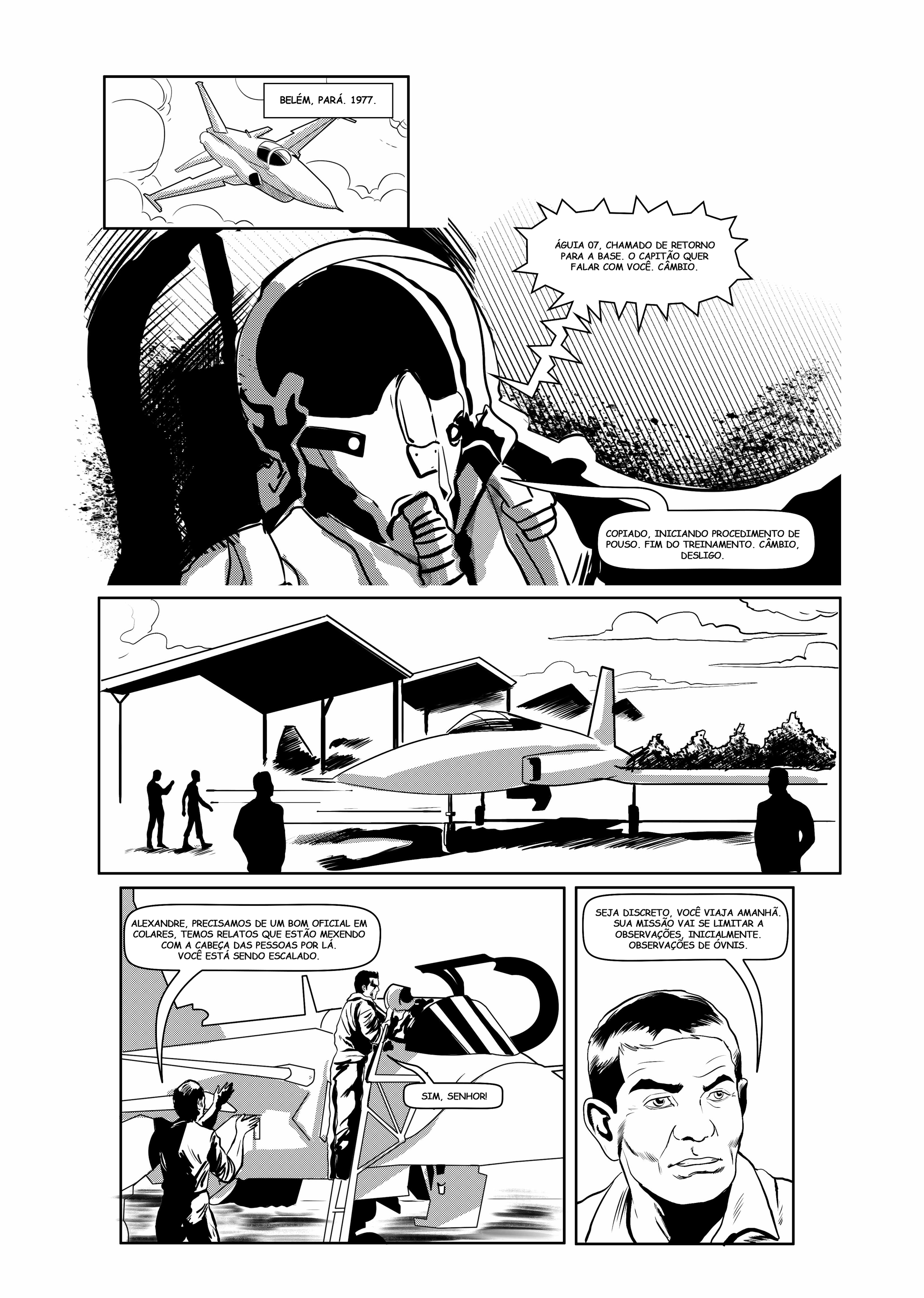
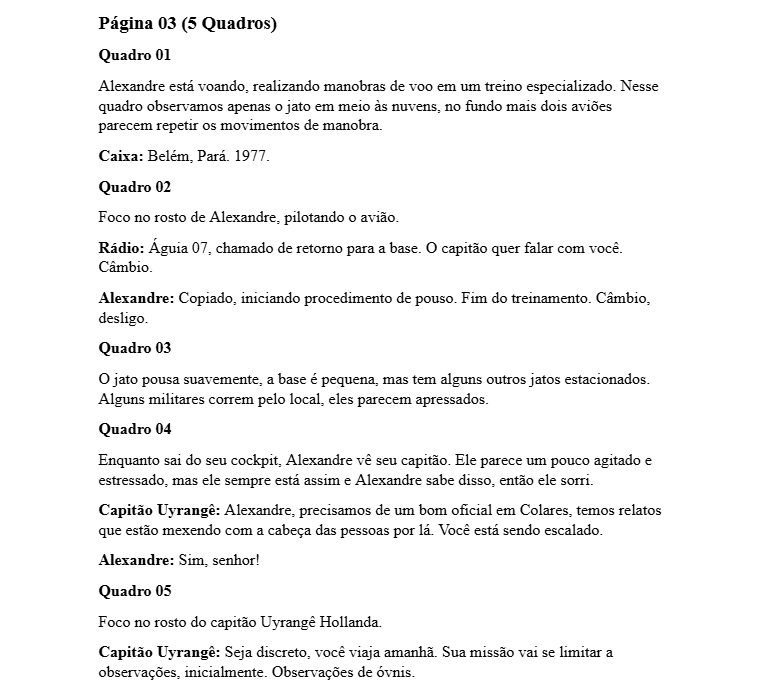
Notice that my script is not followed to the letter, and that is normal in comics. After all, the art faithfully follows the idea and the message; everything is understood and the sequential art tells the page’s story. Notice my formatting too, the brief descriptions, and of course the mistakes I make fairly often by over-detailing or giving too much movement to a single panel. That is also part of my flawed style, which has been correcting itself over time. This script was written in December 2023, and a lot has changed in my writing since then.
On to the next one.
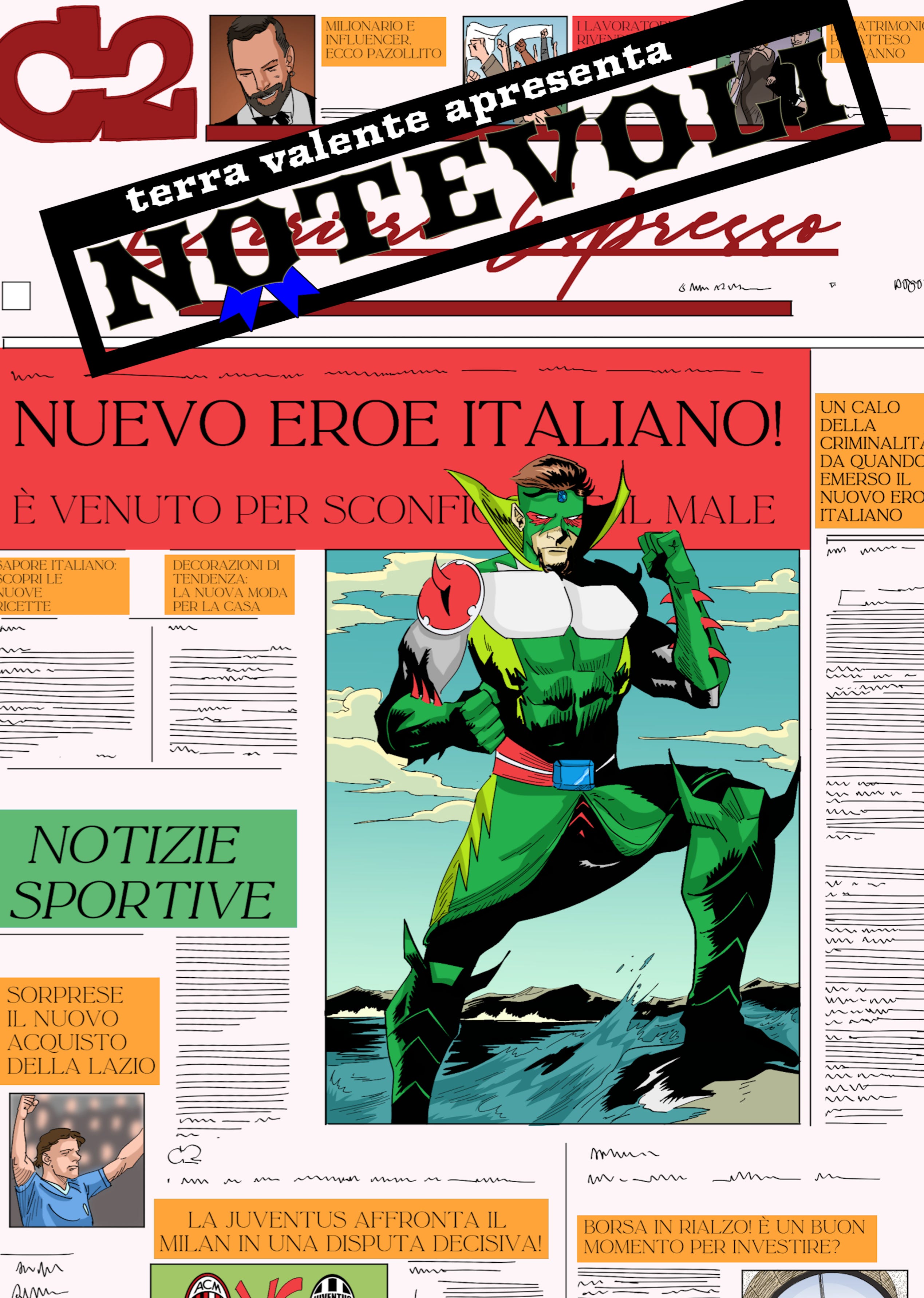
This one was quite challenging. Andrej came up with a team of Italian heroes, and the first of them would be the one on the cover, Scarabeo Verde. I thought, “is this a copy of Blue Beetle?”, and do you know the funniest part of that question? I would be the one to decide. Copy or not, the script sets the direction, and with that in mind I once again gave my best. Notevoli and all the stories involving Scarabeo Verde are among my favorites. Synopsis below.
Three Times Notable Part 1: After an unusual encounter with an alien scarab, Ercolano gains extraordinary superpowers: superhuman strength, enhanced vision and much more. A blessing or a curse? Discover the true story of Scarabeo Verde!
Believe me, nothing in this story is as simple as it seems. This character is extremely complex, and his relationship with that alien scarab is not exactly fun. Here is one of the pages and its script.
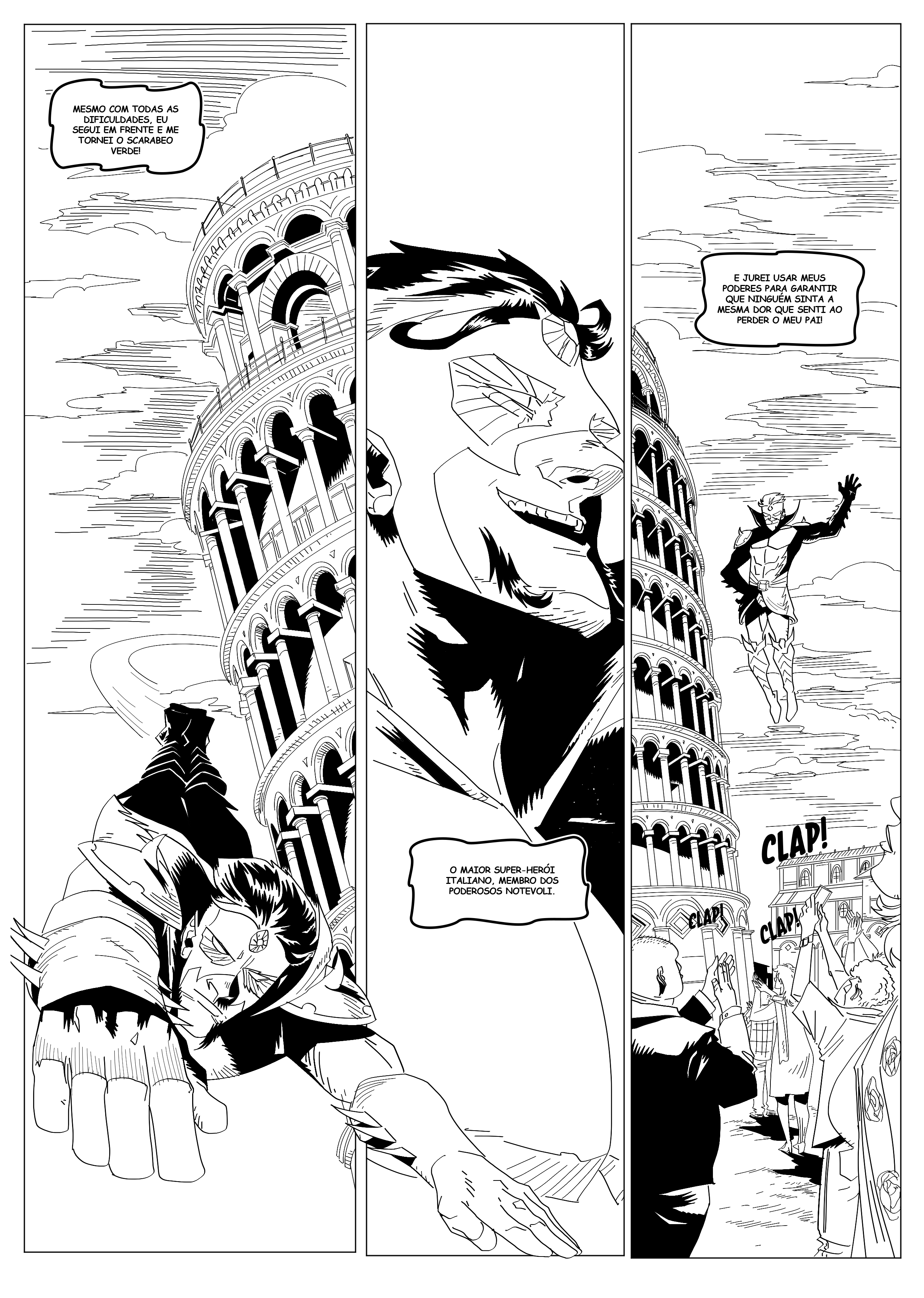
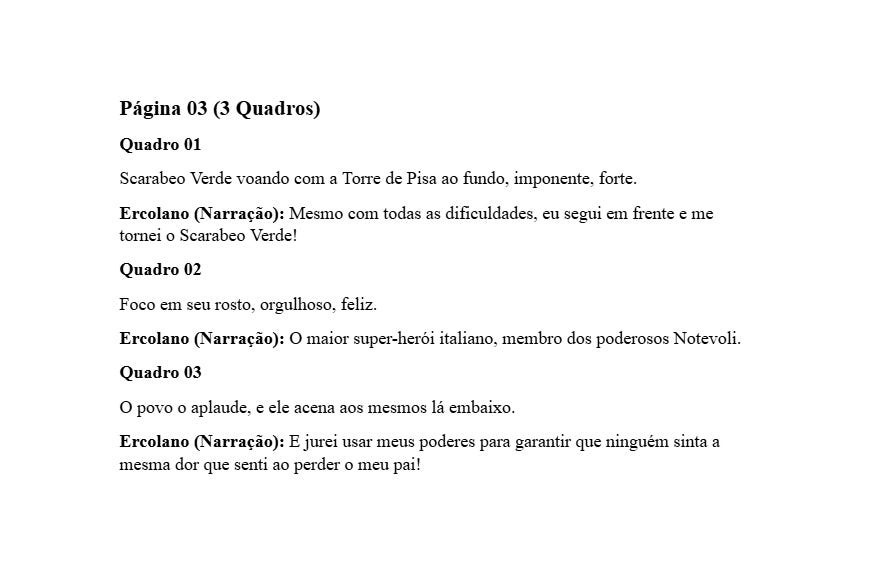
Notice how concise this script is compared to Pedro Lucas’s extravagant art. I am proud of what I write, but I could never picture how perfect the final result would be. Of course, the art does not always surprise me, but this page in particular surprised me in a good way. With few words I managed to tell Pedro Lucas, without sending him a single message, what I was imagining. And he saw it, saw it even better than I did.
Notice that this script’s formatting is identical to the previous one. It has changed a bit over time; today it is still very similar, but different. Formatting matters, I do not take away all its value, but what matters most is understanding the scenes in the order they are described. If the artist can picture that and pull the drawing out of it, bingo, you won.
On to the last one.
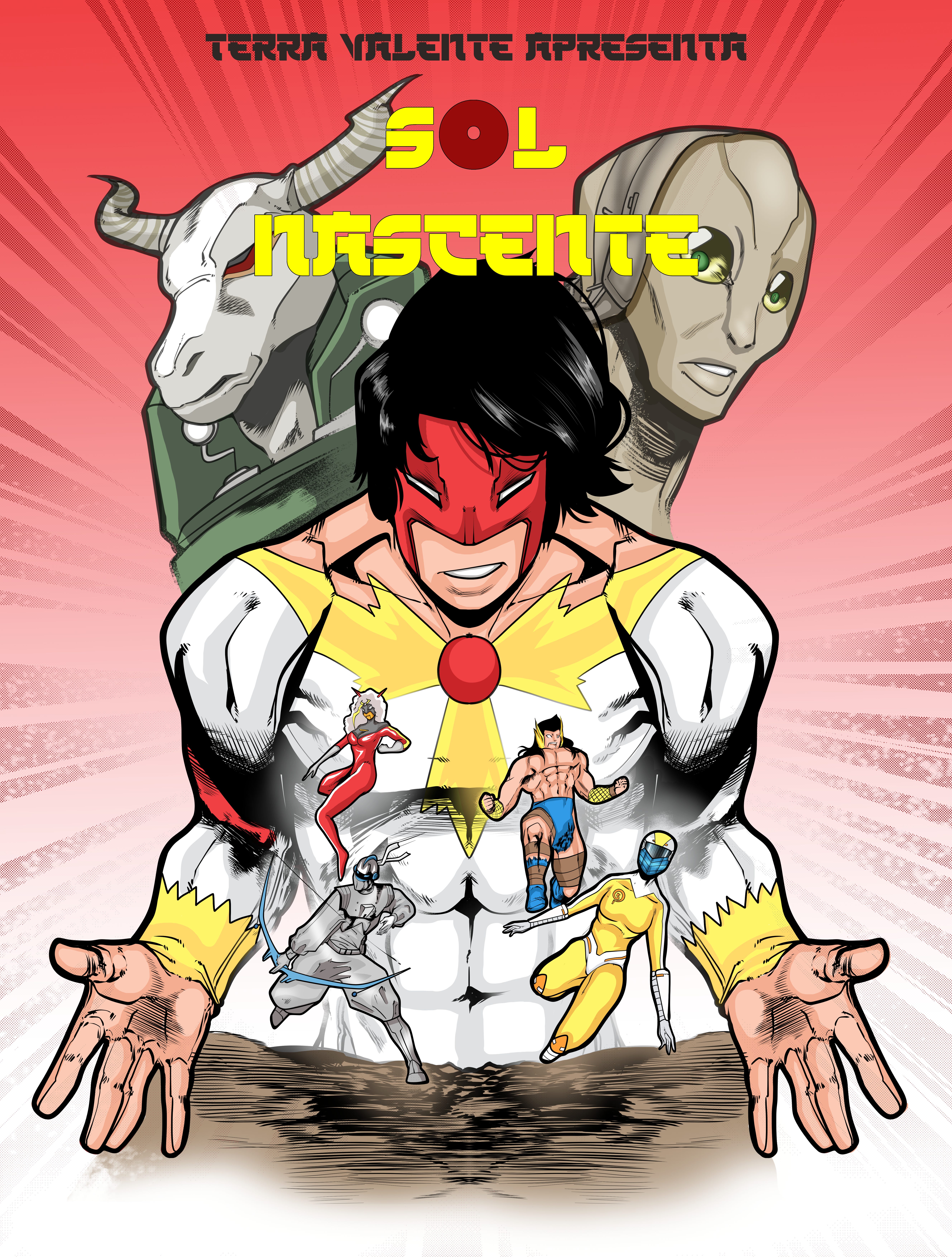
Sol Nascente was the kind of challenge I thought I could not win. Even with the experience and knowledge I had, I thought many times, “I think I overdid it…”, because it was a long story, a graphic novel next to the other 10 to 15-page stories. And long stories need more than coherence; they need to be interesting all the time, because quitting is always easier than continuing, you know that.
I am proud of the final result. I always wanted to do something closer to the Japanese style, and doing it with such an interesting superhero was amazing. Thank you, Andrej. Synopsis below.
When the Eastern Star Shines: After living the first years of his life like any ordinary boy in rural Japan, Michinori sees his life take a surprising turn when a space accident brings an alien right into his home. Yet this is only the tip of the iceberg in a story that will take this young man from Earth into a universe full of possibilities, turning him into Japan’s greatest superhero. Meet Michinori and his companions in this three-chapter story that establishes a team of Japanese superheroes like no other.
Now let us quickly look at a page from this story and its script, before you abandon this newsletter, which is getting longer than I planned.
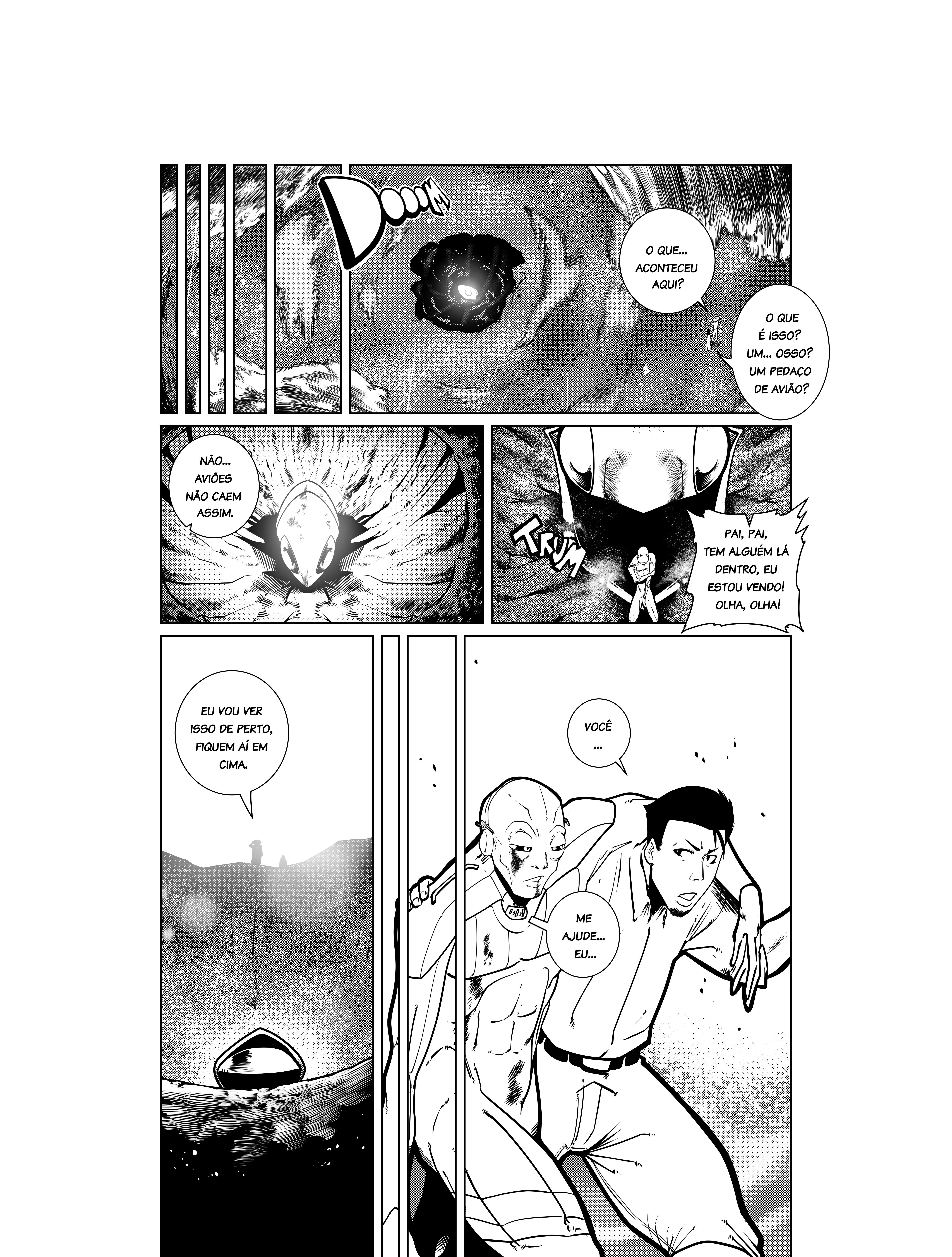
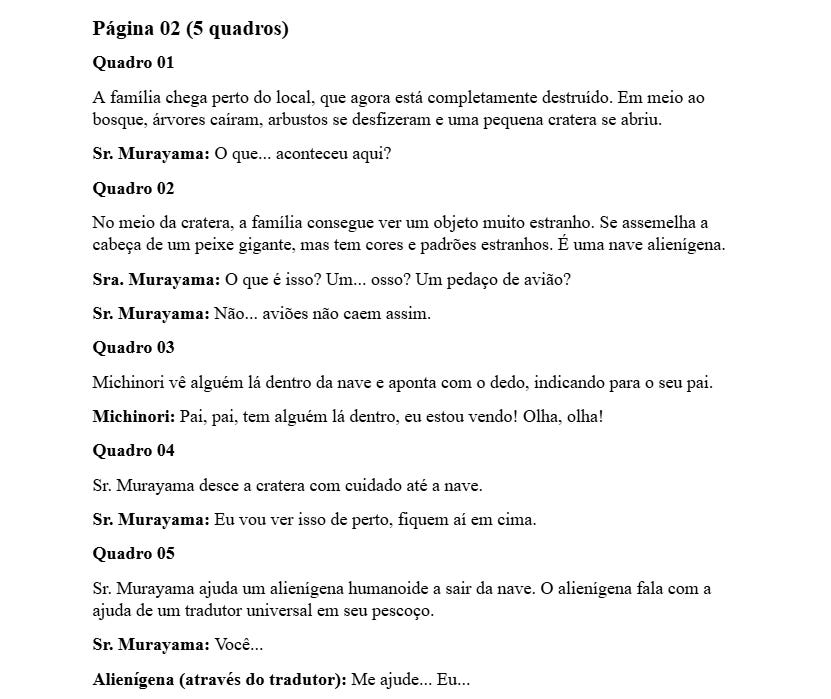
And here we are. This script is quite interesting because I had to work with many things that were new to me, from using a completely new setting to a character’s growth from his childhood to his most heroic moment. It is hard to tell a simple story in an interesting way, just as it is hard to tell an interesting story in few pages. This script in particular has more than 50 pages.
Happy studying if you are preparing to become a comic writer, and of course, if you need me, you know where to find me.
Now let us talk about how you can get these wonderful comics and support the Brazilian scene. And I will tell you, it is not a pretty, wonderful scene, at least not yet. We are fighting for our space. Like it or not, we are still hostages to a culture that is not ours, and I do not even mean American heroes; I mean the American (or European) way of telling stories, whatever they are about.
We have potential, the potential to create our own path, our own way of telling, of creating, of presenting to the world Brazilian and foreign heroes that are our creations. We do not need to bow our heads and silently accept everything we are handed. For that, we need to support what comes from within.
UICLAP and Catarse
After a big disappointment with a publisher (a long story I already summarized in another issue), Andrej decided we should release the comics on our own, in this case on his own. Two ideas came up. The first was Catarse, though asking comic readers for support is quite hard. If you do not have an audience, several social networks and money to invest in marketing, you are just one more pebble in that huge lake of creators.
The Catarse campaign for Terra Valente (our hero universe) is open, and you can back it there, get your rewards and goodies at home, and be happy. The link is here.
Besides that wonderful Catarse idea, we had one more: selling through UICLAP, a direct sale between the platform, which works as a print shop, and the reader, you, who want well-made editions of these wonderful comics. On UICLAP I recommend getting the author’s editions, marked with that name in the titles, and there you will find not only the issues I mentioned here but many more.
The author’s editions are larger and higher quality, and the price is worth it. It is the minimum for us to make the minimum profit, and we know it will not really be profit, just revenue, because the costs of holding this dream in our hands were absurd. The UICLAP link is here.
That is it, folks. I tried to be as brief and concise as possible in this one because, as you know, my goal here is always to deliver valuable content. I do not want you to read this and leave with nothing but an “ad” for something I created. I want you to take something from this text. I want you to finish reading and think “I can write comics too”, because, guess what, you can.
The journey is never easy; that is why it is a journey. Good luck.
See you, explorers!
Originally published in Prosa & Pixel, on Substack. See it on Substack · Subscribe to Prosa & Pixel · All issues